
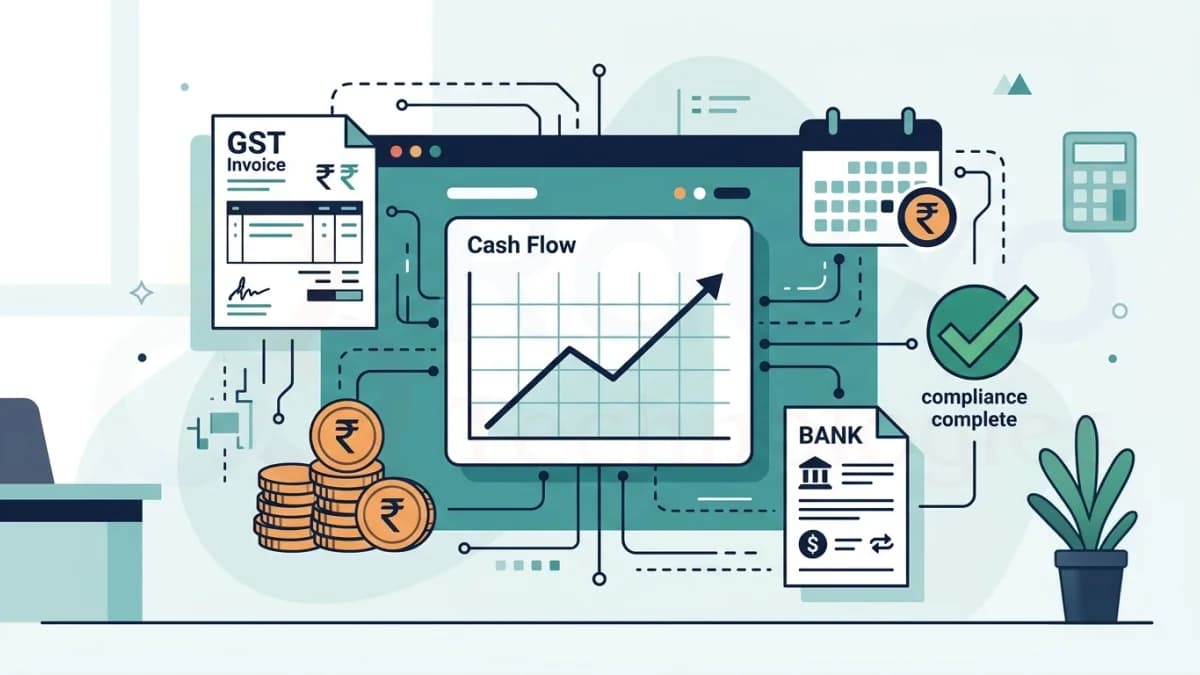
Running a business in India means dealing with GST returns, unpaid invoices, payroll, vendor payments, and cash flow — while also doing the actual work your customers pay you for. Most Indian small business owners are excellent at their trade. Learning to manage business finances as an India small business owner is a different skill, and nobody teaches it when you start.
The cost of learning it the hard way is real. According to CashBook's 2026 cash accounting guide for Indian small businesses, Indian small businesses lose ₹50,000–₹2,00,000 per year from missed deductions, late fees, and avoidable bookkeeping errors. That money is lost to disorganisation, not competition.
This guide covers cash flow, GST, invoicing, collections, payroll, and the systems that connect them — written for owners, not accountants.
The difference between profit and cash flow (most Indian SMBs confuse these)
Profit is what is left after you subtract expenses from revenue — on paper. Cash flow is the money actually moving in and out of your bank account, and what is sitting there right now.
A business can be profitable and still run out of cash. Here is how it happens. You complete a project in June and invoice ₹5 lakh. The client pays in September. But rent, salaries, GST, and vendor payments are due in July and August. On paper, you made a good profit in June. In practice, your account is empty in July.
This is the cash flow trap, and it is one of the most common financial problems for Indian small businesses — from IT service firms in Bangalore to trading companies in Mumbai.
The fix is to track cash flow separately from profit, and to look ahead. A 13-week cash flow forecast is a simple sheet listing the money you expect to receive and must pay, week by week, for the next three months. It shows when cash will run short, so you can act early — delay a purchase, chase a collection, or arrange an overdraft — instead of scrambling.
GST: what every Indian business owner needs to know in 2026
GST (Goods and Services Tax) is the tax you collect from your customers on behalf of the government. You pay it to the government after subtracting the GST you already paid on your own business purchases. Every business above ₹20 lakh turnover (₹10 lakh in special category states) must be GST-registered.
That subtraction is called ITC, or Input Tax Credit. It is one of GST's most valuable features — and one of its biggest headaches for small businesses.
The two GST returns that matter most
- GSTR-1 — your sales details, due by the 11th of every month
- GSTR-3B — your summary of tax owed and paid, due by the 20th of every month
According to TaxGuru's 2026 GST compliance guide, from 2026 the GST portal automatically calculates interest at 18% per annum on late tax payments, and blocks future return filing until overdue returns are cleared. On top of interest, the late fee is ₹50 per day for regular returns (₹20 per day for nil returns). These amounts compound quickly. Set calendar reminders, and do not file on the last day — the portal is often slow around deadlines.
The ITC problem
ITC lets you deduct the GST you paid to suppliers from the GST you owe. But there is a catch: you can only claim it if your supplier has filed their own GSTR-1 and their invoices appear in your GSTR-2B (the monthly statement on the GST portal showing which purchase invoices your suppliers have reported).
If your supplier does not file, you cannot claim the credit — even though you paid the tax. A GST compliance burden study published on Zenodo in 2026 found that nearly 3 out of 4 small manufacturers have experienced disrupted tax credits for exactly this reason. GST compliance research published in IJRTI 2026 reports that 55–60% of Indian small businesses feel cash flow stress specifically because of ITC delays.
For a textile trader in Surat or an engineering unit in Coimbatore with dozens of suppliers, this adds up fast. Check your GSTR-2B monthly and chase missing supplier invoices before the quarter ends.
Working capital and GST
Working capital is the cash your business needs to keep running day to day while you wait to get paid. GST creates a timing mismatch: you pay GST on purchases immediately, but collect GST from your clients only when they pay you.
Hussain and Khan, referenced in IJRTI 2026, found this has increased the working capital gap for Indian manufacturers from 45–60 days before GST to 60–90 days after GST. IICPA Institute's 2026 GST guide for small businesses calls poor cash flow management the single most common reason small businesses struggle with GST — and recommends always keeping a cash reserve of 1–2 months of your typical GST liability, so filing day never catches you short.
Outstanding invoices: the money you've already earned but haven't collected
For most Indian B2B businesses, outstanding collections — money clients owe you but have not yet paid — are a bigger cash flow problem than expenses. A trading company in Mumbai, a facility management company in Chennai, or a distributor in Delhi can carry a lot of earned-but-unpaid money at any time.
Practical fixes:
- Invoice immediately. Every day you delay raising an invoice is a day added to the payment cycle.
- Set clear payment terms. "Payment due in 30 days" or "15 days" — printed on every invoice. Follow up on day 31, not day 60.
- Track outstanding payments systematically — not in your head or in WhatsApp chats. A simple spreadsheet at minimum; a CRM or billing system as you grow. Our plain-language guide to CRM for Indian businesses explains how this works, and our email and CRM services can set it up for you.
- Follow up consistently. Many businesses send one invoice and then wait. A simple sequence works better: a WhatsApp reminder 7 days before the due date, a call on the due date, and a formal reminder 7 days after. It recovers more payments without damaging relationships.
- Put a UPI payment link on every invoice. The easier it is to pay, the faster most clients pay.
Faster collections also make growth easier — a point we cover in how to increase business sales in India in 2026.
Payroll: getting it right every month
If you have employees, payroll is a monthly compliance obligation — not just a bank transfer. Here is what an Indian small business has to track:
- Salary structure — basic salary, HRA (house rent allowance), and other allowances, structured correctly for your employees' tax
- PF (Provident Fund) — a retirement savings contribution of 12% of basic salary from both employer and employee, deposited by the 15th of the following month
- ESI (Employee State Insurance) — a health insurance scheme for employees earning up to ₹21,000 per month, with contributions from both employer and employee
- TDS on salaries — tax deducted from the employee's salary each month if their annual income is above the tax-free limit
- Attendance-linked pay — if your staff work variable days (field staff, contract workers, daily-wage workers), payroll must match actual attendance. Paying 22 days when someone worked 18 causes losses, disputes, and compliance issues.
The most common payroll mistake is calculating salaries by hand from WhatsApp attendance messages. For a manufacturer in Pune or a facility management company in Chennai with staff across several sites, that leads to errors, arguments, and eventually compliance notices. We wrote about this pattern in detail in businesses stuck on WhatsApp and Excel.
Separate your business finances from your personal finances (immediately)
This is one of the most important — and most ignored — steps to manage business finances well in India.
Many sole proprietors and small partnerships use one bank account for everything — business income, personal spending, GST, vendors, and salaries. Your CA cannot tell business expenses from personal ones, ITC claims get compromised, and deductions are missed.
The fix is simple:
- Open a dedicated current account for the business.
- All business income goes in. All business expenses go out.
- Pay yourself a fixed monthly amount from the business account to your personal account, on the same date each month.
This one change makes everything else in this guide — GST, payroll, cash flow forecasting, tax planning — dramatically simpler.
The real problem when you manage business finances: disconnected systems
Here is what finance looks like in most Indian small businesses:
- Sales recorded in a notebook or basic billing software
- Purchases and expenses in Excel or a different app
- Attendance in WhatsApp
- Payroll calculated by hand every month
- GST filed from a mix of all of the above, reconciled by the CA every month
Every gap is a source of errors and surprises. The CA spends their time matching scattered data instead of advising you, and a cash flow forecast is nearly impossible when income and expenses live in different places.
Most owners are not bad with money — they are managing it with disconnected tools. The businesses that handle finances best — a facility management company in Chennai tracking hundreds of employees across many client sites, a trading company in Mumbai with heavy monthly invoicing, a manufacturer in Coimbatore reconciling purchases and sales for ITC, a pharma supplier in Hyderabad with strict compliance needs — are the ones that connect their operations into one system. Sales, invoicing, expenses, attendance, payroll, and outstanding collections in one place. The owner sees a real-time picture. The CA gets clean, accurate data.
Integrated software does not replace your CA — it gives them what they need to work faster and more accurately. Raaxo is not an accounting firm; we build the systems that make your finances visible. Our custom software and ERP work connects billing, invoicing, payroll, and operations into one platform. For a real example, see the EFS Portal case study — an ERP that manages invoicing, payroll, client billing, and payments for a live facility management company in Chennai.
The monthly financial routine every Indian SMB owner should follow
Here is a checklist you can start using today.
Every day
- Record every sale and every expense — do not let them pile up
- Check your bank balance against the money you expect to come in and go out this week
Every week
- Review outstanding invoices — who is overdue? Follow up.
- Check your cash position for the next 30 days — is a shortfall coming?
By the 11th of every month
- File GSTR-1 (your sales details)
By the 15th of every month
- Deposit PF and ESI for the previous month
By the 20th of every month
- File GSTR-3B and pay the GST due
- Check GSTR-2B — are all supplier invoices showing? Follow up on any that are missing.
Every quarter
- Review advance tax (tax paid in instalments during the year), if it applies to you
- Compare your ITC balance with the GST you owe, and sort out gaps before the quarter ends
Every year, before 31 March
- Final tax planning with your CA
- Verify that all TDS deductions have been correctly filed
Working with a CA: what to give them and what to expect
Most Indian small businesses rely on a Chartered Accountant (CA) for GST filing, TDS, and annual returns. The relationship works best when:
- You give them organised, accurate data — not WhatsApp screenshots and mixed-up Excel files
- You meet every quarter, not only in March
- You ask them to explain your upcoming tax liability in advance, rather than explain penalties afterwards
- You treat compliance as a monthly routine, not an annual crisis
A good CA costs far less than the penalties, interest, and lost ITC that come from poor records. According to Agrawal and Sharma's MSME compliance study, referenced in IJRTI 2026, GST compliance costs reach nearly 3% of yearly revenue for smaller Indian businesses. Bringing that cost down starts with giving your CA clean, connected data.
Frequently asked questions
How do I manage GST as a small business owner in India?
Register on the GST portal, then file GSTR-1 by the 11th and GSTR-3B by the 20th of every month. Keep a cash reserve of 1–2 months of your typical GST liability, as IICPA Institute's 2026 guide recommends. Check your GSTR-2B every month to confirm your suppliers' invoices are showing — if they are missing, you cannot claim ITC even though you paid the tax. Set calendar reminders, and never file on the last day.
What is the difference between profit and cash flow for a small business?
Profit is what is left after subtracting expenses from revenue — on paper. Cash flow is the actual money in your bank account. You can be profitable and still run out of cash if clients pay late. Track both separately, and forecast your cash position 8–12 weeks ahead to avoid a crisis.
How do I track outstanding payments from clients in India?
At minimum, keep a spreadsheet of every invoice, due date, and payment status, and review it weekly. Follow up systematically — WhatsApp before the due date, a call on the day, a formal reminder 7 days after — and add UPI links to invoices. As you grow, a CRM or billing system can automate this — see our guide to CRM for Indian businesses.
Should I separate my business and personal bank accounts?
Yes — immediately. One shared account creates accounting chaos and compromises ITC claims. Open a business current account, keep all business money there, and transfer yourself a fixed amount each month.
How can integrated software help with business financial management?
When sales, invoicing, expenses, attendance, and payroll live in one system, your CA files GST faster with fewer errors, you see your cash position in real time, outstanding invoices are tracked automatically, and payroll follows actual attendance. Learn more about our custom software and ERP work.
Take control of your business finances
Managing business finances in India does not have to be a monthly crisis. The right habits, the right tools, and the right CA — with clean, connected data flowing between them — make it predictable and manageable.
If your business still runs on scattered tools and WhatsApp data, that is the first thing worth fixing. It is also the foundation for everything else in our guide to growing your business online in India in 2026. When you are ready to connect your operations, talk to us.
Raaxo Technologies builds integrated business software for Indian companies — from our base in Chennai. We build the systems that connect your operations, so your financial data is clean, accurate, and useful. Tell us about your business.