
You have probably heard "CRM" a hundred times — at a conference, from a vendor, in a LinkedIn post. And each time, the explanation was too technical or too vague to tell you whether you actually need one.
This guide skips the jargon. In plain language: what CRM for Indian business owners actually means, the signs that you need one, what to look for if you run a business in Chennai, Mumbai, or Coimbatore, and when a standard tool is enough versus when you need something built for how your business works.
What is a CRM? (plain language, no jargon)
CRM stands for Customer Relationship Management. For an Indian small business, the plain-language definition is simpler:
A CRM is the system that tracks every customer and every potential customer — where they came from, what they need, what you quoted them, when you last spoke, and what needs to happen next.
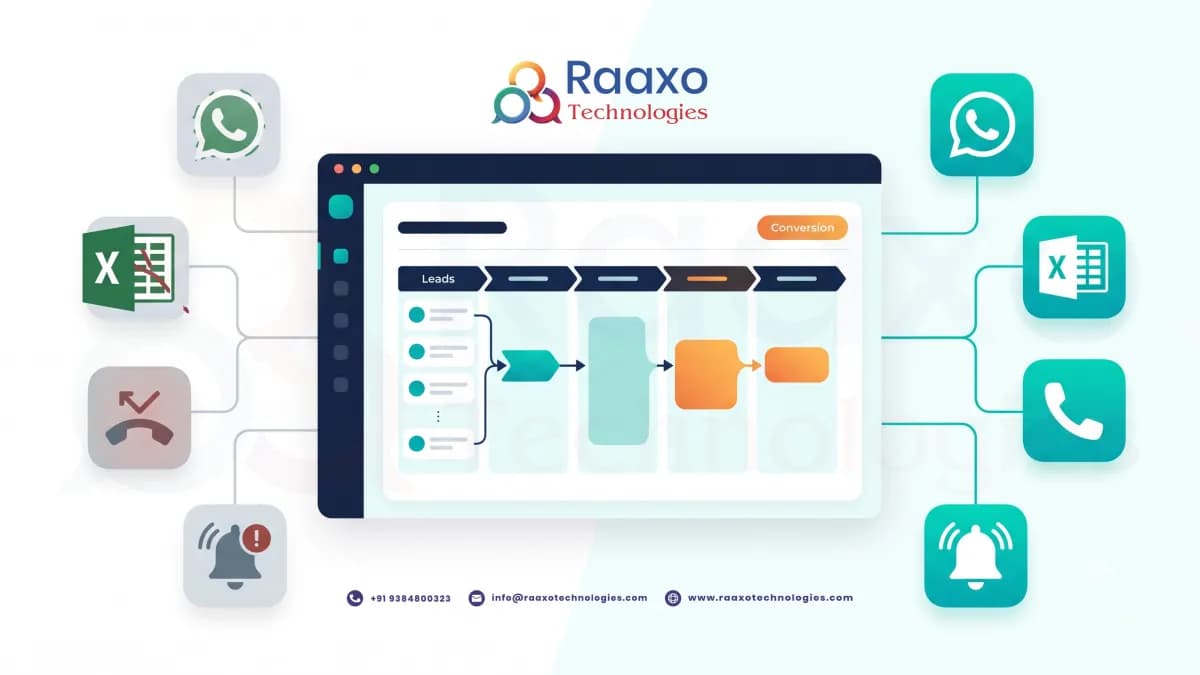
Without a CRM, that information lives in WhatsApp messages, Excel sheets, someone's notebook, and the owner's memory. With a CRM, it lives in one place — accessible to everyone on the team, from any device, at any time.
Think of it this way: if your business were a shop, your CRM is the shopkeeper's memory — except it never forgets, never misplaces a note, and always reminds you when to follow up.
The real problem a CRM solves for Indian businesses
The average Indian SMB loses 60–70% of its leads due to poor follow-up — leads fall through WhatsApp groups, Excel sheets, and the owner's memory, according to Unstop Growth's 2026 CRM guide for Indian small businesses.
A lead comes in on WhatsApp. Someone responds. Then a call. Then silence — because the follow-up got buried in 200 other messages, or the person handling it went on leave, or the owner forgot. That lead goes to a competitor who followed up.
This is not because your business is bad at what it does. It is because you have no system for managing the conversation after the first interest. A CRM fixes that: no lead forgotten, every follow-up on time, every customer getting the attention that turns them into a paying client.
If this sounds familiar, we covered the same pattern in stuck on WhatsApp and Excel and how to increase sales for your business in India.
Signs your Indian business needs a CRM
Read this list. Nod where it fits.
- You received an enquiry on WhatsApp, meant to follow up, and remembered two weeks later when it was too late
- You cannot tell, right now, how many active leads your business has and what stage each one is at
- When a team member goes on leave, their customer conversations go with them — nobody else knows what was discussed
- You have customers who bought once and never heard from you again — not because they were unhappy, but because nobody followed up
- You get leads from multiple places (website, IndiaMART, JustDial, WhatsApp, walk-ins) and they all go to different people or channels
- Your sales process depends entirely on one person's memory or phone
- You spend time every week figuring out who owes you money and who you need to call
If any three of these are true, a CRM will directly improve your business. Managing 5–10 leads a week manually is fine. When digital marketing kicks in and enquiries reach 50–200 per month, manual management fails — again according to Unstop Growth's 2026 CRM analysis.
What a CRM actually does (the key features in plain language)
Stores every customer and lead in one place. Name, contact, where they came from, what they enquired about. No more searching WhatsApp for a conversation from three weeks ago. When deciding who can access these records, how long to retain them and how to explain their use to customers, consult MeitY's DPDP resources and check the requirements and enforcement dates that apply to your business.
Tracks where each lead is in your sales process. Contacted, quote sent, follow-up needed, closed, lost. At any moment you can see your entire pipeline — that simply means your list of active leads and where each one sits.
Reminds you to follow up. A good CRM tells you every morning who you need to call or message today.
Records every interaction. Calls, emails, WhatsApp messages, meetings. When someone goes on leave, their replacement picks up exactly where they left off.
Generates quotes and invoices. Many CRMs include GST-compliant quotation and invoice generation — important for Indian businesses.
Shows you your numbers. How many leads came in, how many converted, where they came from, who is closing the most deals.
WhatsApp integration. For Indian businesses, this is non-negotiable. Most customer conversations happen on WhatsApp, not email, according to Wortal's 2026 guide to CRM software in India. A CRM that does not connect with WhatsApp is not built for the Indian market.
According to JM Origin's 2026 CRM guide for Indian SMEs, CRM helps businesses track leads, close more deals, retain customers, and scale — without increasing headcount. The Indian CRM market is expected to grow at a CAGR of 22%, per NASSCOM, cited in EasyZuvo's 2026 CRM guide.
Who needs a CRM for Indian business — and who doesn't
You probably need a CRM if: you sell something that involves a sales conversation before purchase (B2B manufacturers in Coimbatore, service businesses in Chennai, consultants in Bangalore, distributors in Mumbai, pharma suppliers in Hyderabad); you have more than 10 active leads; more than one person handles sales; you get leads from multiple sources (website, WhatsApp, IndiaMART, JustDial, referrals); or you want to grow without growing your team at the same rate.
You probably don't need a CRM yet if: you have fewer than 5 long-term stable customers; your sales process is one conversation followed by a standard purchase; or you are very early-stage and manage every lead yourself through personal relationships.
The honest reality: most Indian businesses that think they do not need a CRM already need one. The pain usually arrives when digital marketing starts and leads flow faster than manual tracking can handle — the same pattern behind why your business isn't growing online. Small teams often benefit the most, because every missed lead hurts more when every lead matters, according to TeleCRM's 2026 affordable CRM guide for India. That applies whether you are an auto supplier in Pune, a logistics firm in Delhi, or a gems trader in Jaipur.
Off-the-shelf CRM vs custom CRM for Indian businesses
Off-the-shelf CRM — standard products in the market — is faster to set up, lower upfront cost, and already tested. Right when your sales process is fairly standard: enquiry, call, quote, close. Many affordable options exist in India, some with free tiers. Features that matter for India: WhatsApp integration, GST-compliant invoices and quotes, an Android-friendly mobile app, and local support.
Custom CRM is the right choice when your workflow does not fit a template. A Chennai-based tax and CA practice we work with needed more than lead tracking — a client portal where clients see tax filing status live, PF/ESI and compliance work by client and due date, and GST-compliant invoicing with partial payments. No standard CRM handled that combination. A custom system now runs their entire client lifecycle — the kind of work we do with custom software and ERP and email and CRM systems.
The rule: if your process is a straight line (enquiry → quote → follow-up → close), a standard CRM works. If it has complexity — client portals, compliance, multiple service lines, billing integration — custom is worth it. If you are weighing a ready-made product against building your own, read custom CRM vs ready-made CRM software.
How much does a CRM cost in India?
- Free tier: ₹0/month — limited, good for starting
- Standard off-the-shelf: ₹850–₹2,500 per user per month
- Premium with WhatsApp and automation: ₹2,500–₹5,000 per user per month
- Custom CRM: typically ₹3L–₹10L+ depending on scope
The cost of not having a CRM — losing 60–70% of leads to poor follow-up — is almost always more than implementing one.
Where to start this week
- Write down how you manage leads today — sources, first contact, who follows up, how you track each stage.
- Find the biggest leak: first contact too slow, no follow-up after the first conversation, or quote sent then silence? Getting more leads from your website only helps if you can catch them.
- Under 50 leads a month and a simple process? Try a free tier of a standard CRM this week for 30 days.
- Complex process, or standard tools have failed you? Talk to someone who builds custom systems. Tell us about your business.
Frequently asked questions
What is a CRM in simple terms for an Indian business?
A CRM tracks every customer and potential customer — where they are in your sales process, what you discussed, and when to follow up. For most Indian businesses, it replaces WhatsApp groups, Excel sheets, and the owner's memory.
Does a small business in India really need CRM software?
If you lose track of leads, miss follow-ups, or cannot say how many active prospects you have — yes. Managing 5–10 leads a week manually is fine; at 50–200 per month from digital marketing, manual management fails.
What is the most important feature to look for in a CRM for an Indian business?
WhatsApp integration. Most Indian customer conversations happen on WhatsApp, not email. After that: an Android-friendly mobile app, GST-compliant invoicing, and ease of use for non-technical staff.
What is the difference between a CRM and an ERP?
A CRM covers the customer-facing side — leads, sales, follow-ups. An ERP (Enterprise Resource Planning) covers internal operations — payroll, inventory, billing, compliance, field work. Many start with one and add the other as they grow. We build both under custom software and ERP.
Should I use an off-the-shelf CRM or have one built for my business?
Straightforward process (enquiry → quote → follow-up → close)? Start with a standard off-the-shelf CRM. Complexity that standard tools cannot handle — client portals, compliance, multiple service lines — points to a custom CRM.
If you are not sure whether you need a CRM, a standard tool, or want to have a CRM built for your business — that is the conversation worth starting. Tell us about your business.
Raaxo Technologies builds custom CRM systems, client portals, and business software for companies across India — from our base in Chennai. We build what fits your business, not the other way around. Tell us about your business.