
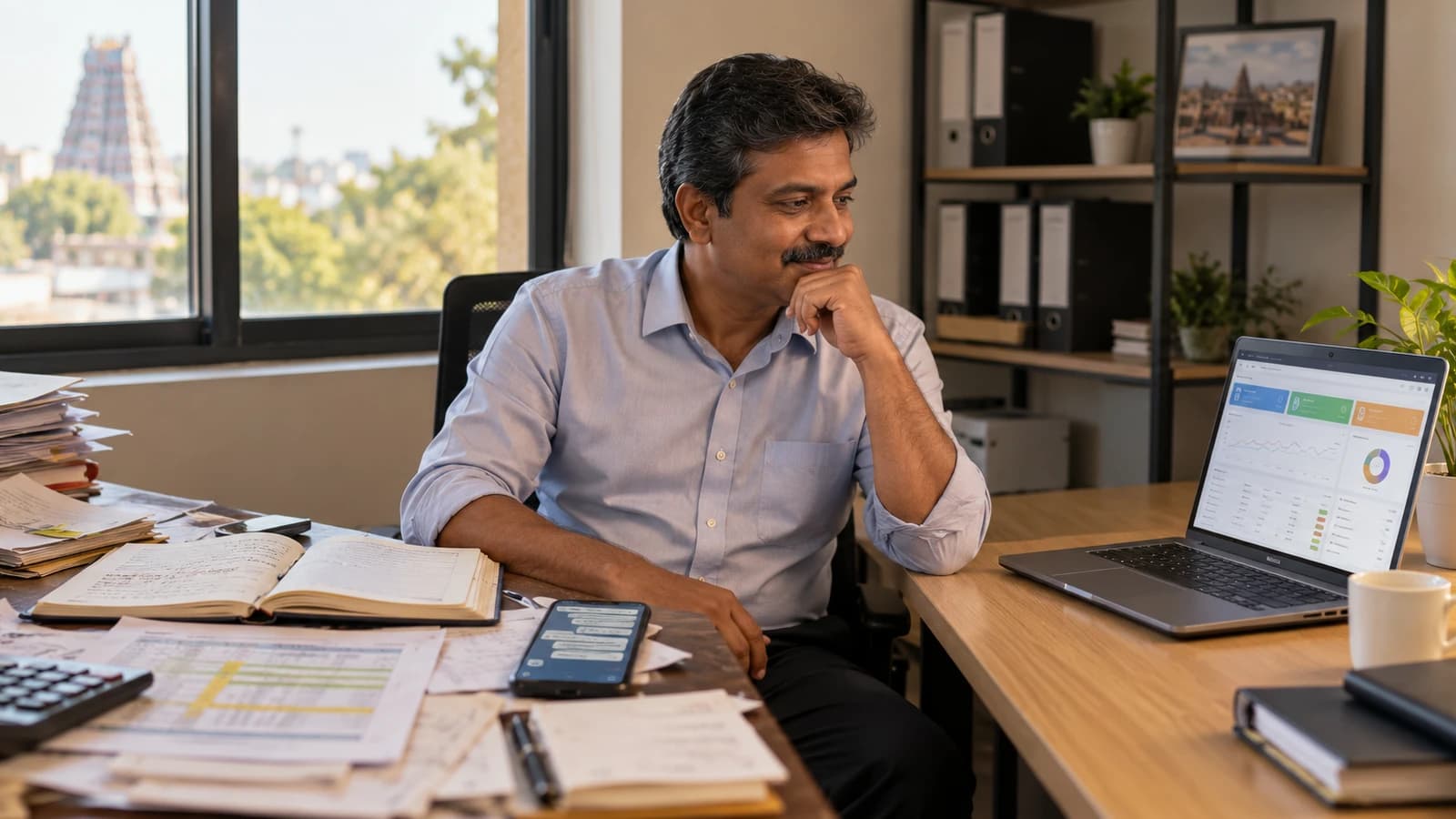
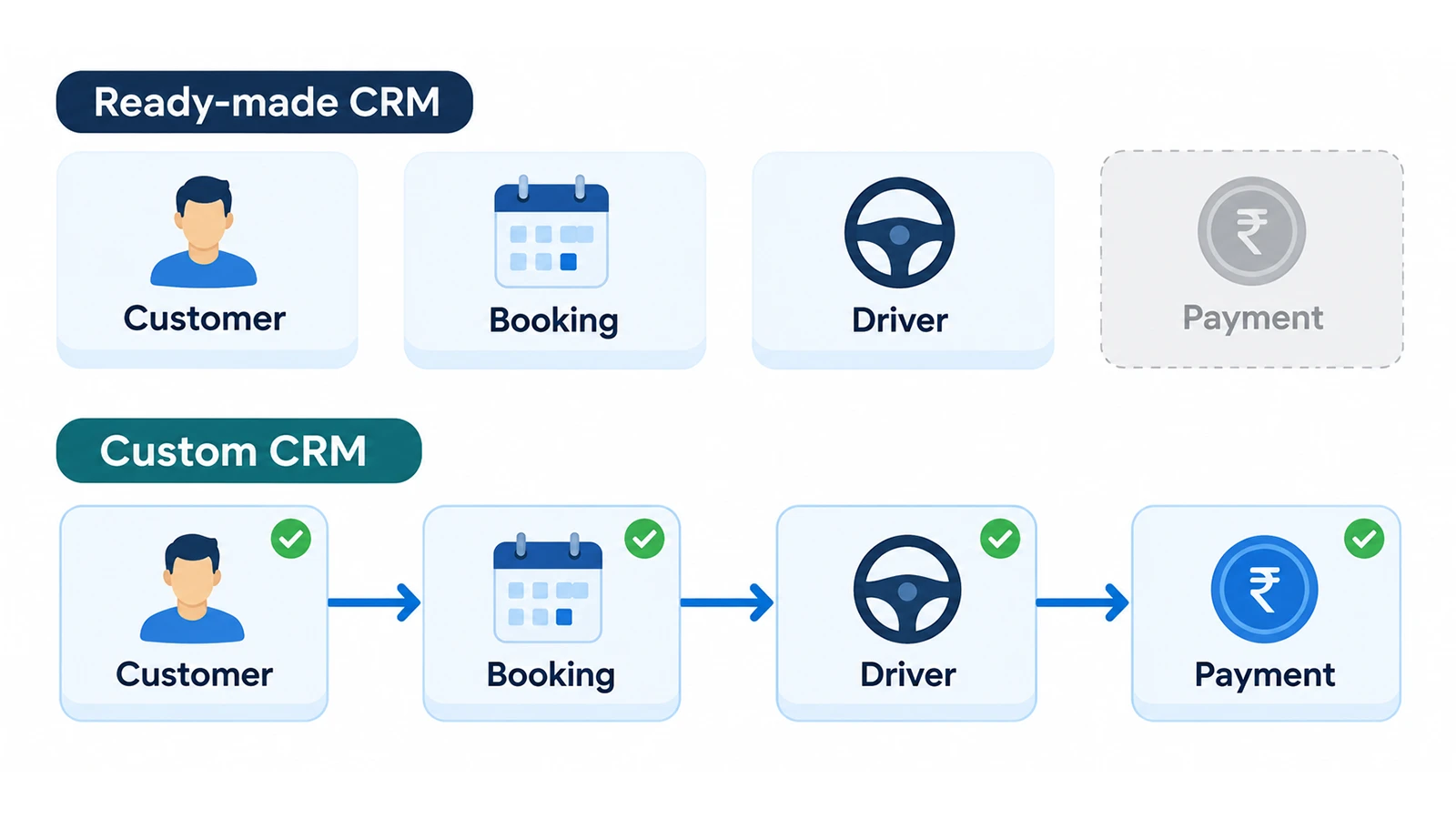
A chauffeur service we work with once bought a CRM from an online marketplace. It looked complete. Their business runs on calls: a customer phones, the team records the booking, assigns a driver, and the payment is collected when the trip ends. The CRM could store customers, but it could not follow that sequence from call to driver to payment. There was no way to record a payment against a booking. The team ended up working around the software instead of with it.
That story is the whole debate in miniature. Ready-made CRM software is built for an average business. The question is how far your business is from that average.
The short answer
A ready-made CRM is the right choice if you mainly need to keep customer records and raise simple invoices, with no operations linked to them. Add a customer, note the conversation, send an invoice: almost any ready-made product does that well, and quickly.
A custom CRM makes sense when your operations run through the customer record: bookings that need a driver or technician assigned, contracts with site-wise billing, compliance deadlines per client, payments collected in the field. That is where general-purpose software starts to bend your process to fit itself.
Most Indian small businesses are not on either yet. In a survey of more than 10,000 grassroots MSMEs, 97% used WhatsApp but only 14% used CRM software. For many, the real comparison is not custom versus ready-made. It is either of them versus Excel and WhatsApp.
What ready-made CRM software does well
It is fair to start here. Ready-made CRMs are quick to set up, cost little for a small team, and come with mobile apps, reports and updates you do not have to think about. If your sales process is simple and standard, buying is sensible and building would be wasted money.
Where ready-made CRMs fall short for Indian businesses
Your process is not their process. A ready-made product decides the order of steps for you. The chauffeur service needed booking, driver assignment and payment as one flow; the product treated them as unrelated records. Workarounds pile up, and staff go back to WhatsApp and notebooks.
The features you need often sit in a higher plan. Published prices for paid plans in India run roughly ₹400 to ₹2,600 per user per month (vendors' published pricing, October 2026). Custom modules, advanced automation, API access and extra storage are usually reserved for the top tiers or sold as add-ons. You pay for every user, every month, for as long as you use it.
Prices rise. Software subscriptions have been getting more expensive across the market: one tracker of SaaS pricing recorded a 16.4% year-on-year rise in June 2026. A cost that looks small in year one compounds with every user you add.
India-specific needs are an afterthought. Four come up again and again:
- WhatsApp is where your customers already are. India has more than 500 million WhatsApp users, and business messages are now charged per template message. A CRM should send the right reminders and confirmations without you paying for messages nobody needed.
- GST e-invoicing has deadlines. E-invoicing is mandatory above ₹5 crore turnover, and businesses above ₹10 crore must report invoices to the government portal within 30 days. If quotations in your CRM become invoices by hand, that gap is where delays happen.
- India's data protection law is arriving. Under the Digital Personal Data Protection Rules notified in November 2025, most business obligations apply from May 2027: clear consent, handling customer requests within 90 days, reporting breaches, keeping logs, with penalties up to ₹250 crore. Whatever CRM you choose now should already support that.
- Not every team works best in English. 57% of Indian internet users prefer regional-language content. For field and sales staff, a Tamil screen can be the difference between a system that is used and one that is avoided.
Leaving is harder than joining. Your customer history lives on someone else's platform. Exporting it is possible, but the workflows, automations and reports you built stay behind.
What a custom CRM changes
SRK Services, a tax and compliance practice in Chennai, ran everything on Excel: client lists, deadlines, quotations, invoices. When they saw the ERP we had built for Easy Facility Services, they decided they wanted a system of their own rather than a ready-made CRM.
The work in a tax practice is not a sales pipeline. It is income tax, GST, PF and ESI deadlines for every client, each with its own documents and its own progress. So the system we built for SRK is organised around that: client records, quotations and invoices, compliance work tracked per client, and a client portal where clients see their compliance status, download documents and view invoices themselves. A general-purpose CRM would have needed so much customisation that it would no longer be general-purpose.
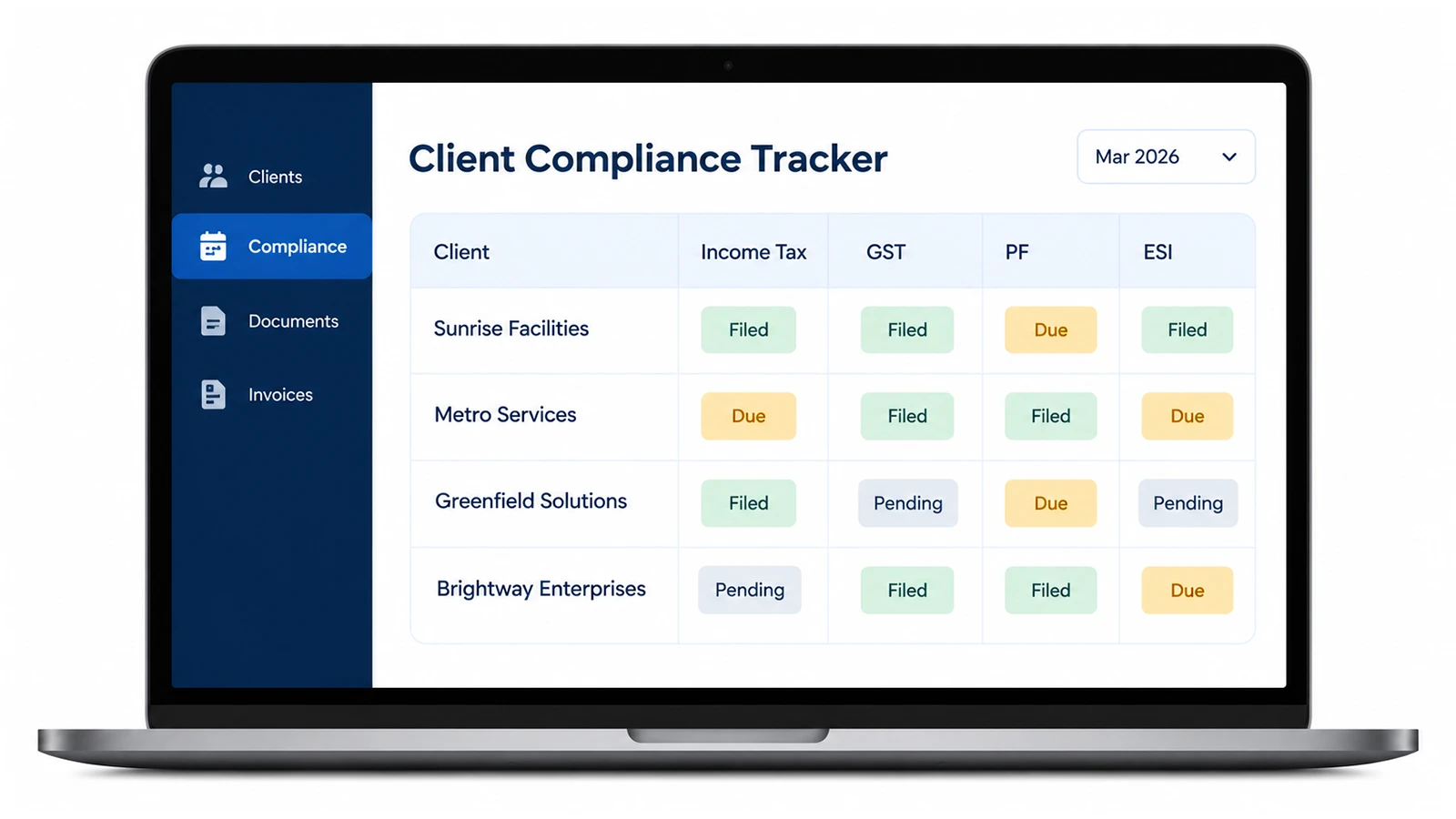
Illustrative mockup with fictional data
A custom CRM changes three things:
- It follows your sequence. Booking, assignment, completion and payment can be one flow, with each step recorded where it happens.
- It grows a module at a time. Start with the part costing you the most time; add WhatsApp messages, accounting sync or GST e-invoicing when they are worth paying for, not because a plan bundles them.
- It speaks your team's language. English, Tamil or any other language your staff work in.
How the cost really compares
The two models are paid for differently, and that matters more than the headline price.
| Ready-made CRM software | Custom CRM | |
|---|---|---|
| How you pay | Per user, every month, for as long as you use it | An agreed build cost, then optional support |
| Adding a user | Adds to the monthly bill | No extra licence |
| Features you need | Often in a higher plan or an add-on | Built because you need them |
| Price changes | Set by the vendor | Agreed with you in advance |
| Hosting | The vendor's platform | Your own hosting account, in your name |
| Leaving | Export what you can; workflows stay behind | You keep the system and the data |
A custom build costs more on day one. Over a few years, with a growing team, the per-user model often costs more. Which is cheaper depends on your users, your process and how long you plan to use it. Before you decide, we prepare a cost comparison for your own numbers: what a ready-made plan would cost for your team, and what a custom system would cost to build and run.
Who owns what
With a custom CRM from us, the hosting is set up in your name. We handle deployment and support after development and testing, but the system and the customer data are yours. If you ever change vendors, nothing is locked away on someone else's platform.
Why CRMs disappoint, custom or ready-made
The software is rarely the main reason. Research into CRM projects keeps finding the same causes: unclear goals, staff left out of the decision, resistance to change, and treating the CRM as an IT project rather than a change in how the business works.
You may have read that "70% of CRM projects fail". That figure has never been traced to a real study, so we do not repeat it. The useful lesson is simpler: start with one workflow your team already struggles with, involve the people who will use it every day, and grow from there.
A simple way to decide
| Ask yourself | Leans ready-made | Leans custom |
|---|---|---|
| What do you mainly need? | Customer records and simple invoices | Bookings, jobs, contracts or compliance linked to customers |
| Does your process follow a standard sales pipeline? | Yes | No, it has its own sequence |
| How many people will use it? | A few, and stable | A growing team |
| Do you need WhatsApp, accounting or e-invoicing connected? | Not yet | Yes, or soon |
| Does your team need a regional-language screen? | No | Yes |
| How important is owning your system and data? | Not a priority | Important |
If most of your answers sit in the left column, a ready-made CRM will serve you well, and we would tell you so. If they sit on the right, read how we approach custom CRM development, or start with what a CRM is and whether you need one.
Frequently asked questions
Is a custom CRM always more expensive?
It costs more to start. Over time, a per-user subscription for a growing team can cost more than a system you own. We prepare a comparison for your own numbers before you decide.
Who owns the code and the data?
You do. Hosting is set up in your name, and clients who want it own the software and the code outright, under NDA.
Can a custom CRM send WhatsApp messages?
Yes. Confirmations, reminders and follow-ups can go out on WhatsApp from inside the system.
Can it connect to our accounting software or GST e-invoicing?
Yes, when it is worth it for your business. Both involve setup and, for e-invoicing, API costs, so we add them when they save you more than they cost.
Can the CRM be in Tamil?
Yes. We can build the screens in Tamil or any other language your team works in.
Will it be ready for the data protection law?
We build role-based access as standard, and can add the other pieces the law expects, such as consent records and activity logs. Full compliance also depends on your own policies, so confirm the details with your legal adviser.
Not sure which fits?
Tell us how your business runs today, even if it is all Excel and WhatsApp. We will tell you honestly whether a ready-made CRM is enough, and if it is not, show you what a custom one would look like and cost. Start the conversation.