
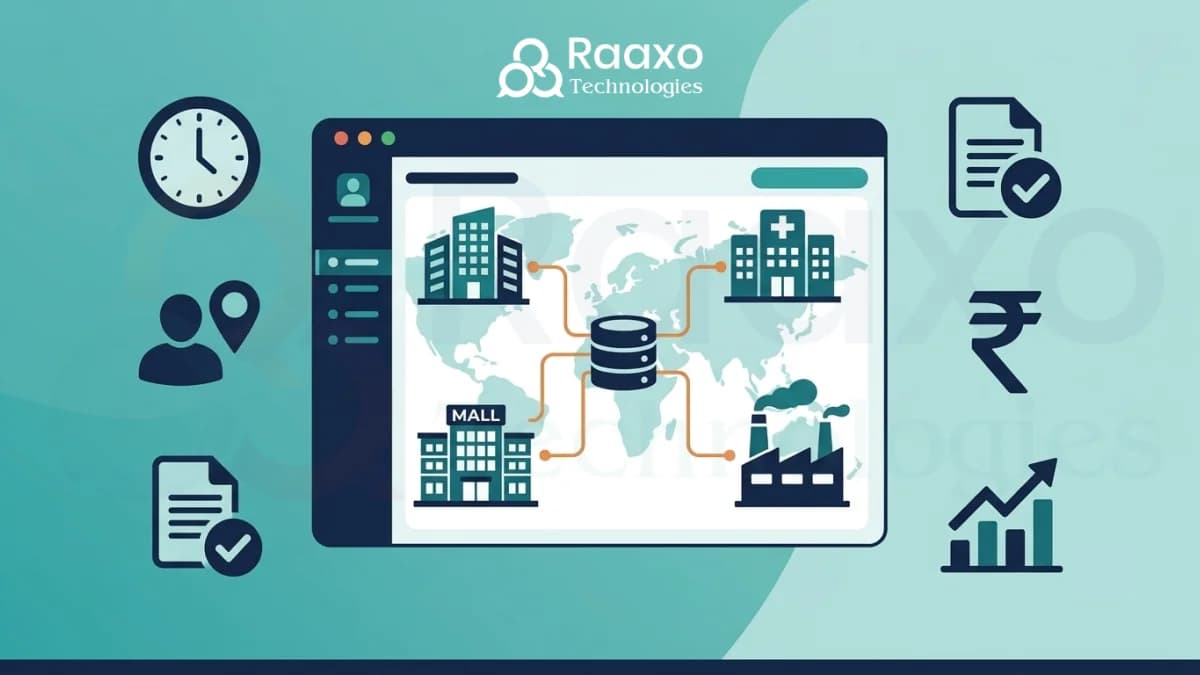
Picture a facility management company in Chennai running security, housekeeping, and technical services across 25 client sites. 180 employees. Attendance marked in paper registers at each site, then WhatsApp-messaged to the office every morning. Payroll built from those messages in Excel at month-end. Service requests arriving by phone and chat. Client reports typed manually in Word.
That is not an unusual story — it is how most Indian FM companies still operate in 2026. And the cost is not soft. According to HROne's 2026 attendance management guide for India, Indian mid-market firms lose an estimated 2.2–2.8% of monthly payroll to buddy-punching, manual register errors, and reconciliation drift. SalaryBox's 2026 multi-location attendance management guide puts payroll error rates from manually managed multi-location attendance at up to 15%. The facility management software India companies need exists to stop exactly this leakage — and to give owners their mornings back.
Manual processes — handwritten daily logs, phone-based dispatching, delayed paperwork — also drive cost overruns and material leakage for Indian FM operations, according to Construction Estimator India's 2026 field service software guide. Tools that worked at five sites break at fifty.
The real cost of running FM operations on WhatsApp and Excel
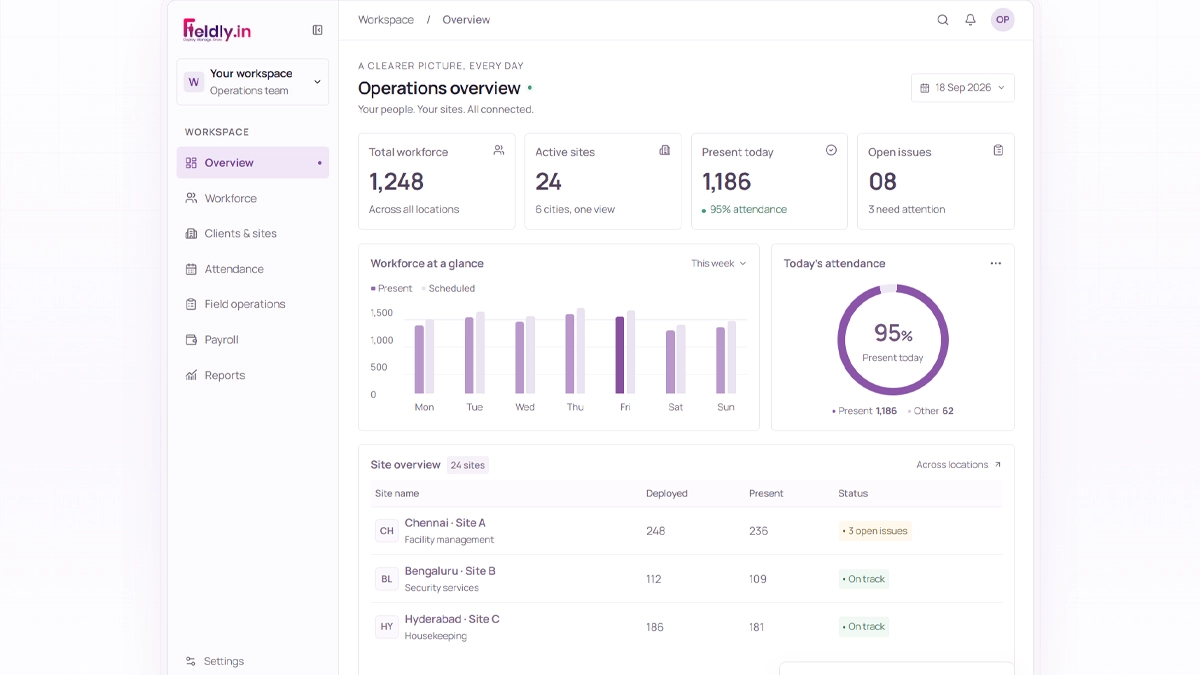 The Operations Overview — 1,248 workforce across 24 active sites in 6 cities, 1,186 present today at 95% attendance. Chennai, Bengaluru, and Hyderabad sites visible at a glance.
Start with payroll, because that is where the money quietly leaves.
If your FM company pays ₹30 lakh in monthly wages, a 2.2–2.8% leakage (HROne 2026) means ₹66,000–₹84,000 lost every month — roughly ₹8–10 lakh a year — to buddy punching, register mistakes, and reconciliation drift. That is money you already earned on the contract and then paid out incorrectly.
Beyond the maths, attendance fraud is common in Indian FM. A guard marks a colleague present. A supervisor adjusts a paper register to avoid deductions. With registers at twenty client sites in Mumbai, Bangalore, or Delhi, there is almost no way to catch it. WhatsApp photos of attendance sheets feel like control. They are not.
Corporate clients in 2026 are raising the bar. Many now ask for digital proof of deployment — real-time attendance, GPS check-ins, service completion records — not a scanned register. When you renew a contract for an IT park in Bangalore or a hospital campus in Hyderabad, paper-only reporting is a competitive disadvantage.
If this sounds familiar, you are not alone. We wrote earlier about businesses stuck on WhatsApp and Excel — FM companies are a clear example of that pattern at scale.
What facility management software India actually does for an FM company
Purpose-built operations software is not "another app." It is a continuous flow: deploy people, track attendance and location, manage work and compliance, pay accurately, and analyse what is happening across sites.
Deploy — right people, right place, right time
Before a shift starts, the operations manager should know who is assigned to which post at which client site. Schedules live in the system, not a notebook. When someone calls in sick at 6am, the system shows who is available nearby — instead of a scramble of phone calls to fill a critical security post. For agencies running rotating shifts across multiple posts inside one Mumbai corporate complex, that alone saves hours every week.
Track — attendance, location, compliance across all sites
Every employee marks attendance from their own phone — GPS-verified, time-stamped, hard to fake from another location. Supervisors see live attendance across all sites from one dashboard. No more WhatsApp attendance photos that may or may not match reality. No more paper registers that can be altered after the fact. For FM companies with workers across corporate offices in Mumbai, manufacturing plants in Pune, and hospital facilities in Hyderabad, centralised real-time attendance is how you run payroll and client billing without arguing about the numbers later.
Manage — workforce, service requests, compliance
Service requests from clients should land in one place — not three WhatsApp numbers and a missed call log. Job assignments go out through the system. Completion is confirmed with photo proof and digital sign-off. Housekeeping contractors managing daily rounds across a corporate campus in Delhi or Coimbatore increasingly replace paper checklists with digital ones — supervisors verify quality with photos, and that evidence becomes the client report.
Pay — payroll and billing visibility
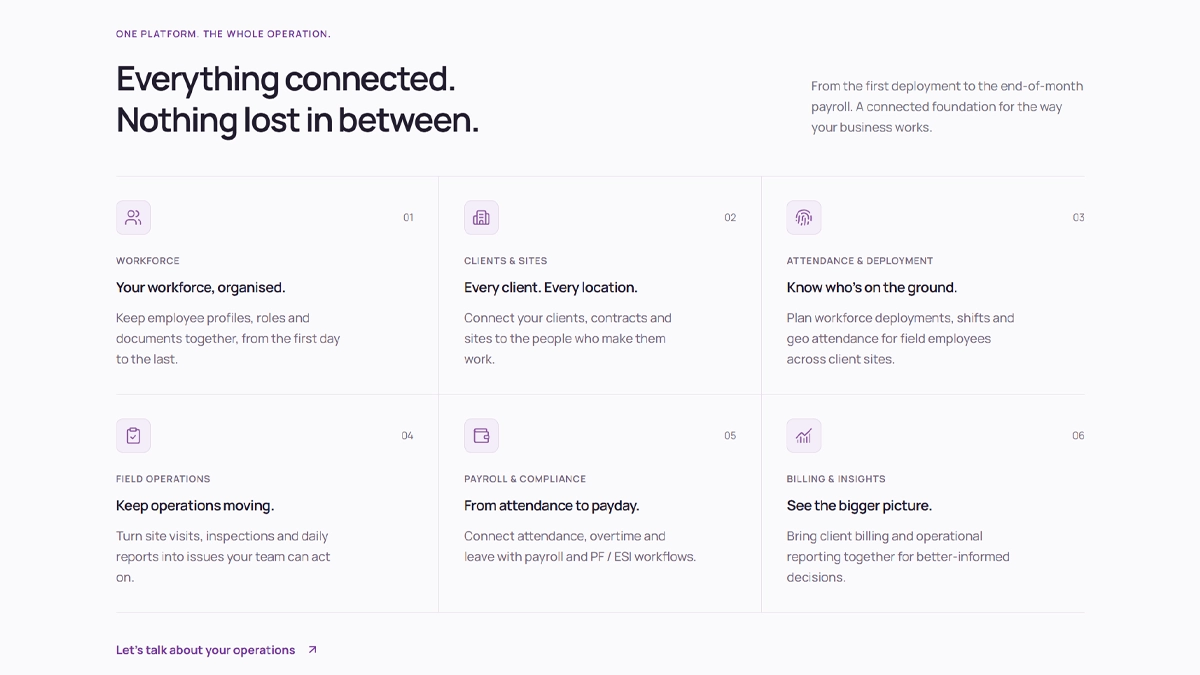 Six connected modules — from workforce and site management to attendance, field operations, payroll compliance, and billing insights. Everything in one flow.
Attendance data should flow into payroll without a second Excel exercise. For manpower companies paying weekly or biweekly wages, accurate attendance means accurate wages and fewer disputes. For FM companies billing clients on actual manpower deployed, accurate attendance means accurate GST-compliant invoices. SalaryBox's 2026 multi-location attendance management guide is blunt: multi-location attendance managed manually leads to payroll error rates of up to 15%. Connected attendance and payroll cuts that error out of the process.
Analyse — reports and business insights
The owner who used to spend Monday mornings calling site supervisors for updates can instead see the previous week across all sites on one screen — attendance issues, service backlogs, categories running over budget.
According to PropertyAutomate's 2026 FM software guide for India, the transition to facility management software is no longer only about fixing operations faster — it is about data-led decision-making. By 2026, the gap between tech-first and legacy FM companies will help define who attracts top clients and who keeps healthy margins. That same shift shows up when Indian businesses move from spreadsheets to purpose-built systems — a pattern we cover in how Indian businesses use custom software.
The multi-site problem: why standard software fails FM companies
Generic HR or payroll tools assume people work at your office. FM does not work that way.
Your workers are at client sites — attendance cannot sit on a biometric machine at company HQ. The same employee may work at different sites on different days, and billing must know which client owns each day's work. Clients have different rates, service types, and SLAs. Compliance for contract workers includes PF, ESI, and the Four Labour Codes — not a simple head-office payroll file. Guard and housekeeping rounds need verification beyond "present." Security shifts run 8-hour and 12-hour rotations across three cycles — the operations manager should not recalculate that by hand every week.
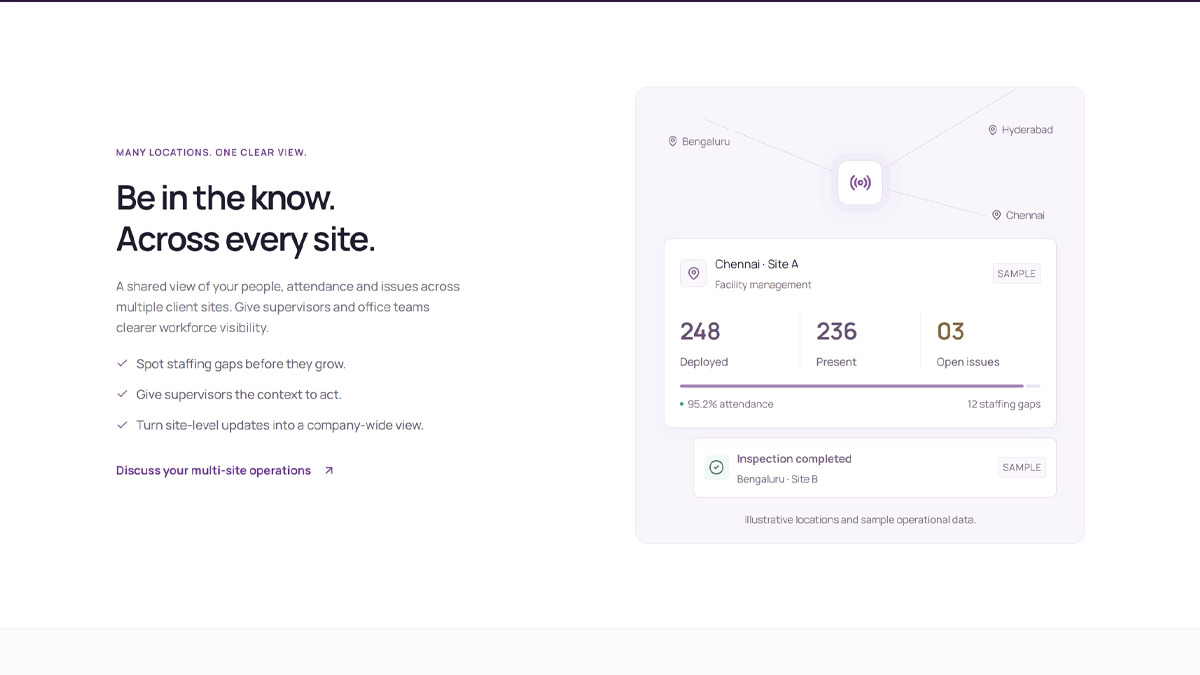 Be in the know across every site — Chennai Site A shows 248 deployed, 236 present, 95.2% attendance, and 12 staffing gaps at a glance.
Fogwing's 2026 facility management software guide for India notes that FM has changed massively: multi-site operations across corporate offices, hospitals, manufacturing plants, commercial buildings, shopping malls, and educational campuses need centralised visibility into workforce and maintenance work. Generic HR software was never designed for that map.
Raaxo has already built this kind of system for a live FM operator — see the EFS Portal ERP case study. That is why purpose-built FM operations software matters more than bolting another module onto desk-job HR. For a wider custom build, our custom software and ERP work follows the same operations-first approach.
What to look for in facility management software India
If you are evaluating options, use a practical checklist — not a feature brochure.
- Multi-site architecture — designed around sites and clients, not only employees and departments
- Mobile-first for field workers — supervisors and guards are not at desks; it must work on budget Android phones, ideally with offline support
- GPS attendance verification — clock-in that confirms the person is at the correct site
- Client reporting — attendance and service reports per client and per site, in the format corporate clients expect
- Payroll integration — attendance into payroll without a manual reconciliation week
- WhatsApp coexistence — Indian FM runs on WhatsApp; good software works alongside it, not against it
- Indian compliance — PF, ESI, contract labour rules, and the Four Labour Codes built in
- Scalable pricing — per site or per employee as you grow, not enterprise pricing meant for a company ten times your size
Clear operations also support growth. When reporting and billing are trustworthy, sales conversations get easier — see how to increase business sales in India in 2026.
Introducing Fieldly.in — built for Indian FM companies
Once the problem is clear, the product choice becomes clearer too.
Fieldly.in is a workforce and operations platform built specifically for Indian facility management, security, housekeeping, manpower, and field service companies. The idea is simple: every site, every employee, one connected platform.
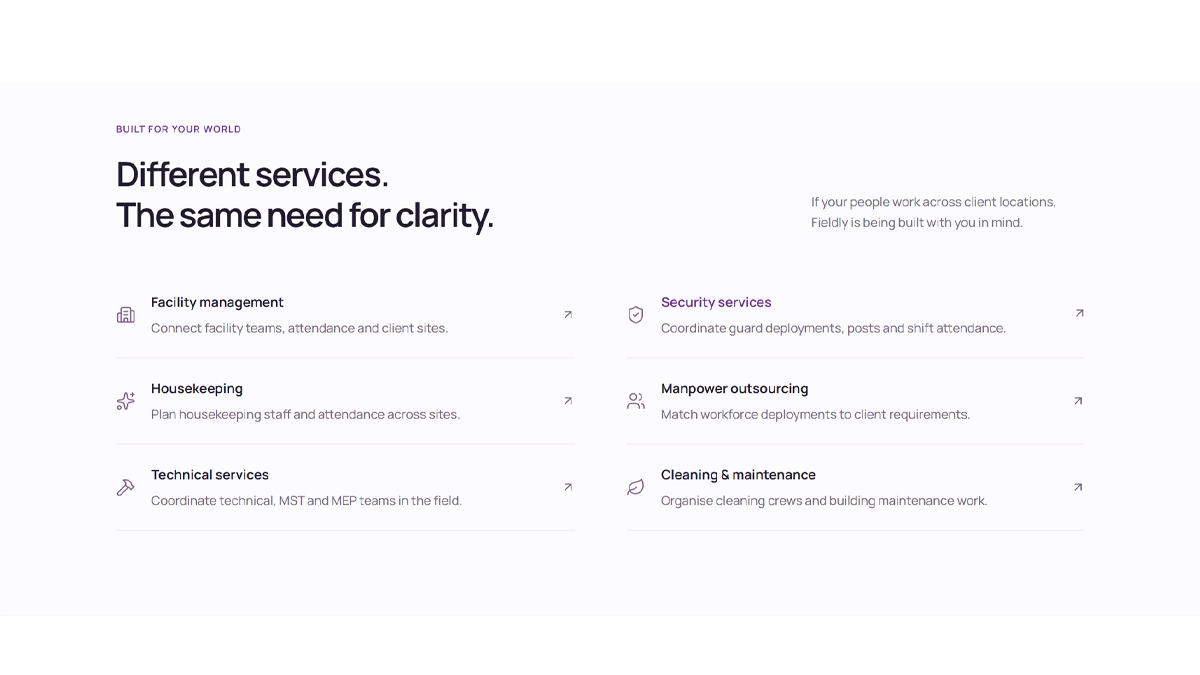 Built for every field service business — facility management, security, housekeeping, manpower outsourcing, technical services, and cleaning and maintenance.
It covers the full operational picture: deploy the right people, track attendance and location, manage service requests and compliance, process payroll with visibility, and analyse performance — from any device. It is shaped around how Indian FM companies actually work: multiple client sites, contract workers, rotating shifts, WhatsApp-heavy communication, and corporate clients who want digital proof of service. Built ground-up for the Indian market — from Chennai IT parks and Coimbatore industrial campuses to Mumbai malls and Delhi corporate complexes.
Signs your FM company is ready for operations software
If three or four of these feel uncomfortably familiar, you are ready:
- Your operations manager spends more than an hour every morning collecting attendance from site supervisors
- You have found discrepancies between reported attendance and actual deployment at client sites
- A corporate client asked for digital attendance records and you could not provide them cleanly
- Payroll takes more than three days because attendance reconciliation takes that long
- You lost — or nearly lost — a renewal partly because reporting was manual and slow
- You cannot say, right now, how many employees are deployed across all your sites today
- A billing dispute took weeks because attendance records were unclear
- Operations work at your current size, but you cannot see how to scale without everything breaking
Those are not IT problems. They are margin and growth problems.
Frequently asked questions
What is facility management software and does my company need it?
Facility management software manages workforce, attendance, service requests, payroll, and client reporting from one system. If you manage workers across multiple client sites and still track attendance on WhatsApp and Excel, the right platform will cut payroll errors, improve client reporting, and free the hours spent on manual coordination.
How does attendance tracking work for field workers?
Modern FM software uses GPS-verified mobile attendance. Each worker marks attendance on their own phone; the system confirms they are at the correct site. Supervisors see real-time attendance across all sites from a dashboard. That reduces buddy punching, removes the paper register as the source of truth, and gives accurate data for payroll and client billing.
How much do Indian FM companies lose to payroll errors?
Indian mid-market firms lose an estimated 2.2–2.8% of monthly payroll to buddy-punching, manual errors, and reconciliation drift, according to HROne's 2026 attendance management guide for India. Multi-location manual tracking produces payroll error rates of up to 15%, per SalaryBox's 2026 multi-location attendance management guide. For an FM company with ₹30 lakh monthly payroll, that is ₹66,000–₹84,000 a month that proper software can help recover.
Can FM software handle contract workers and compliance?
Yes — software built for the Indian FM market should handle contract labour rules, PF and ESI for contract workers, and the Four Labour Codes. It should generate compliance-ready reports and track statutory obligations per worker, per site, and per client.
Is Fieldly.in only for large FM companies?
No. Fieldly.in is built for growing Indian FM companies — security agencies, housekeeping contractors, manpower firms, technical service providers — not only enterprises with large IT teams. It works on budget Android phones, scales from a handful of sites to dozens, and fits companies that have outgrown WhatsApp and Excel but are not ready for heavy enterprise software.
Ready to run every site from one platform?
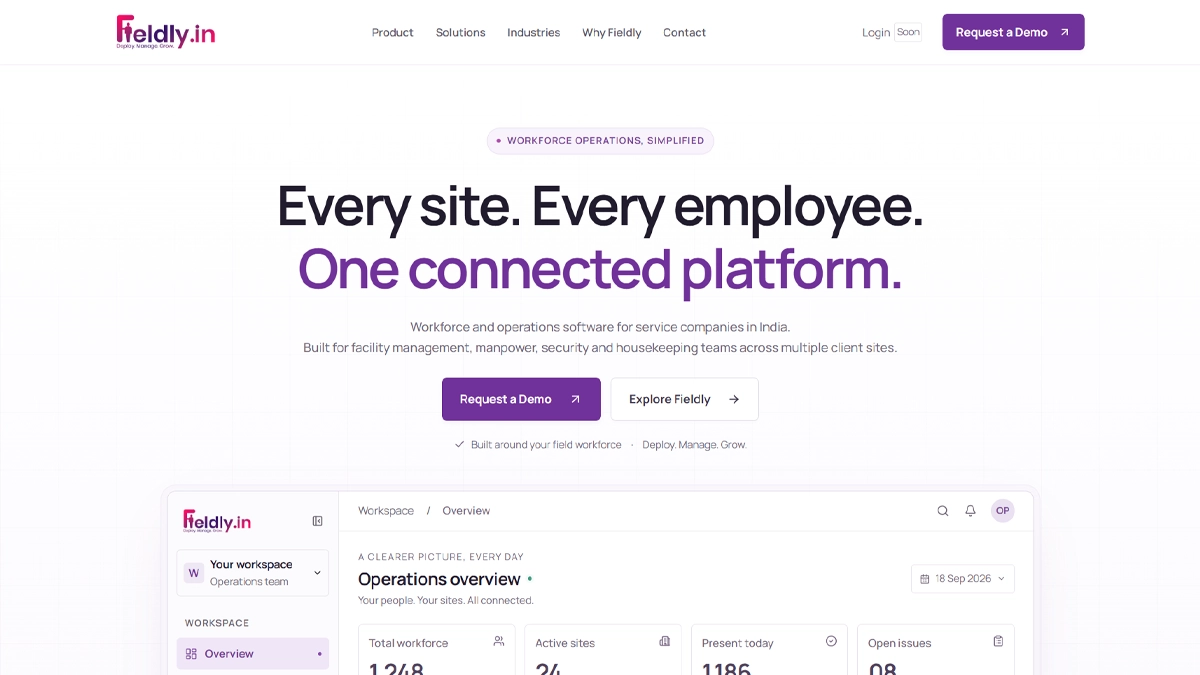 Fieldly.in — every site. Every employee. One connected platform. Built for Indian FM, security, housekeeping, manpower, and field service companies.
If your FM company manages multiple sites and still runs the day on WhatsApp groups, Excel sheets, and phone calls, Fieldly.in is built for you. Early access is available now — request a demo or join the waitlist on the site.
Prefer a custom operations build for your exact workflow? Contact Raaxo and we will walk through your sites, attendance, and client reporting needs.
Raaxo Technologies builds custom software for field service and operations businesses across India — from our base in Chennai. Fieldly.in is our purpose-built platform for Indian FM companies. Visit fieldly.in or talk to us about your operations.