
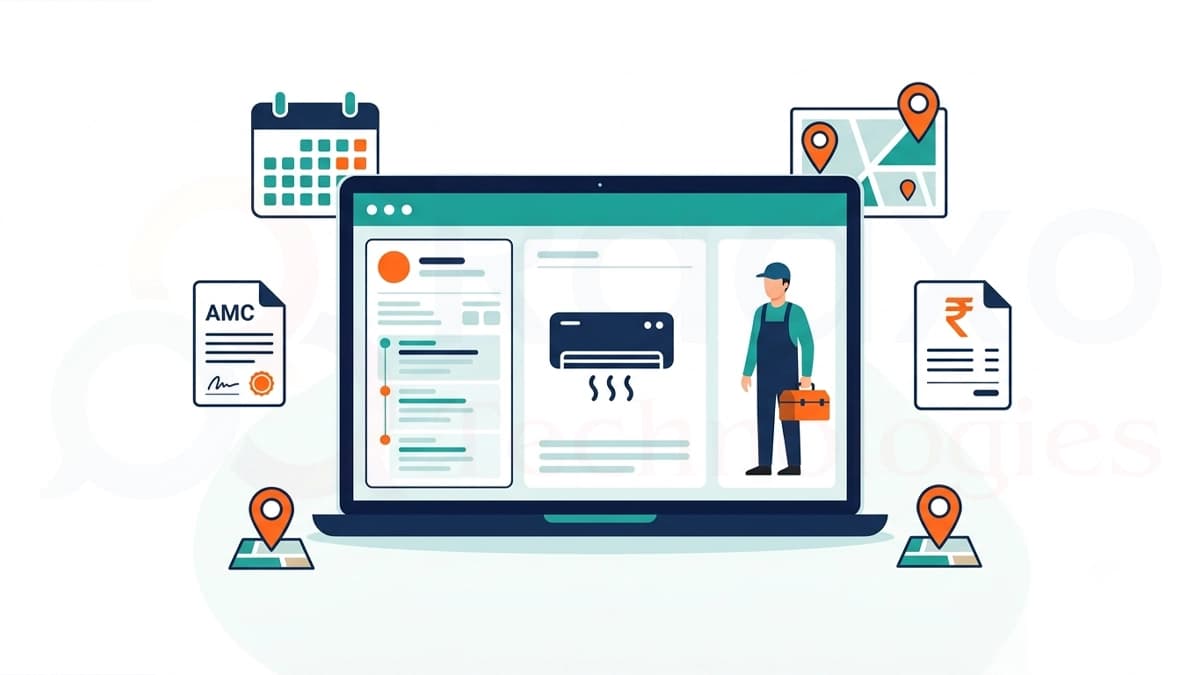
A Chennai HVAC contractor manages 150 AMC contracts. Service requests arrive on three WhatsApp numbers. Technician schedules live in a notebook. Nobody knows whether a spare part is available until the technician calls from the customer site. Invoices are raised manually in an accounting tool or Excel, while payment status lives in someone's memory.
It works — until a renewal is missed, a technician arrives without the right part, an overdue invoice goes unnoticed for three months, or a key employee goes on leave and takes all the context with them. HVAC service management software in India is built to replace this exact situation: one system for the whole operation, from first enquiry to AMC renewal.
This guide explains what that system does, who needs it, and what we have learned while building one for a Chennai-based HVAC company.
The ACHS Portal login screen — branded for Air Cool HVAC Systems, Chennai. Every technician, manager, and admin gets their own secure access.
The operational reality of running an HVAC business in India
An HVAC business is more complicated than selling an air conditioner and completing one installation. You may be responsible for hundreds of machines across dozens of customer sites, each with its own service history, contract terms, maintenance dates, spare-part needs, and equipment type.
A residential split AC does not need the same technician or service plan as a chiller, AHU, FCU, or VRF/VRV system. A hospital in Chennai cannot treat preventive maintenance casually. A data centre in Bangalore needs precise cooling records. A pharma plant in Hyderabad may need maintenance records that support its quality processes. Offices, malls, and hotels in Mumbai can carry a high volume of AMC work across many sites.
AMC means Annual Maintenance Contract. It is the recurring agreement under which an HVAC company maintains equipment for a fixed period. For many Indian HVAC businesses, AMC income is the stable part of the year: installations may rise and fall, but contracted maintenance continues.
Yet AMC data in most Indian service businesses is still maintained through registers, Excel sheets, and WhatsApp messages, according to ServiceKhata360's 2026 AMC management guide for India. AntMyERP's 2026 AMC management software guide says many service companies lose 15–25% of AMC revenue through missed renewals, manual Excel tracking, incorrect billing, and poor visibility into contract performance.
The problem is running a complex service operation with disconnected tools.
What HVAC service management software in India actually does
The clearest explanation is to follow one customer from first enquiry to final payment.
A new enquiry arrives by phone, website, referral, or WhatsApp. It is saved as a lead, meaning a potential customer, with their contact details, source, and requirement. The salesperson arranges a site visit. The customer's site is then registered with its address, notes, contacts, and equipment list.
A quotation is created using the company's service catalogue. If the customer approves it, their details and equipment become permanent records. When they request service, the office creates a service request and a job card — the work instruction that tells a technician where to go, what the problem is, and what must be recorded.
The scheduling screen shows which technicians are available. The job goes to someone with the right skills. After completing it, the technician records the work and spare parts used. The office raises an invoice from the completed job, records the payment, and can immediately see any outstanding balance.
For an AMC customer, the contract includes the visit schedule and renewal date. The PM schedule — short for Preventive Maintenance schedule — creates planned visits at the correct intervals instead of waiting for someone to remember them.
The full system can include:
- Dashboard: a live overview of the business
- CRM: leads, customers, sites, and equipment records
- Masters: standard service catalogue, spare parts, and technicians
- Service: requests, job cards, and scheduling
- Contracts: AMC contracts and PM schedules
- Billing: quotations, invoices, payments, and outstanding balances
- Back office: suppliers, purchases, inventory, and expenses
- Insight: reports for decisions
- Administration: users, roles, settings, and activity history
CRM means Customer Relationship Management: one place that tracks potential and existing customers, conversations, quotations, and follow-ups. Our plain-language guide to CRM for Indian businesses explains it in more detail.
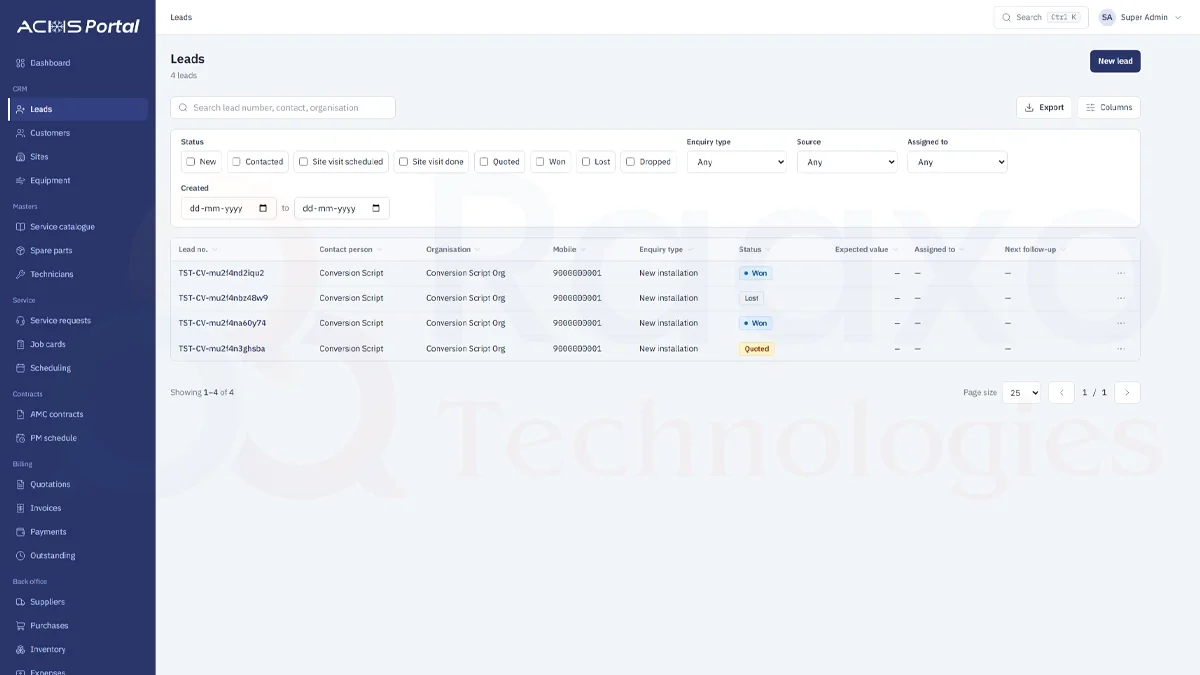
The leads pipeline — every enquiry tracked from first contact through site visit, quotation, and close. Status filters show New, Contacted, Quoted, Won, Lost at a glance. The full module list in the sidebar shows the complete scope: CRM, Service, Contracts, Billing, Back office, and Reports.
Every step flows through one system. WhatsApp remains useful for quick communication, but it no longer has to serve as the company's filing cabinet.
The AMC problem: where HVAC businesses leak revenue
AMC contracts are predictable recurring revenue and the backbone of a healthy service business. Managing them manually is also where money quietly disappears.
A business with 100 contracts, each covering two visits a year, must plan 200 visits annually. Each needs the right date, technician, parts, and completion record. The office must also know when to invoice and when to discuss renewal. One missed visit can become a complaint; repeated misses can cost the renewal.
According to eBizIndia's 2026 AMC software guide, the clearest return from AMC management software appears when a business manages 50 or more active contracts. At that point, a calendar and spreadsheet depend too heavily on people remembering every exception.
A proper system shows contracts nearing renewal, PM visits due this week, visits already missed, services completed, and invoices still unpaid. The owner can see the health of recurring revenue without calling three employees and opening five sheets.
It also creates a record for the customer. When a facility manager asks what happened during the last visit, the answer is available immediately — not buried in a technician's WhatsApp history.
The technician and scheduling problem
Many HVAC owners start each morning with the same scramble: Who is available? Who is nearest? Who understands this equipment? Who has the required spare part? Which customer is already waiting?
Without a scheduling system, these questions are settled through calls and WhatsApp messages. Changes create more messages. A technician is delayed at one site, the next customer is not informed, and the coordinator spends the day rearranging work.
With scheduling software, the office sees available technicians and assigned jobs in one place. Each technician receives a clear job card on their phone with the address, contact person, equipment, complaint, and previous history. Completed work returns to the same record.
FieldServicePro's 2026 HVAC software guide says small HVAC teams moving from manual tracking to field service software report saving 6–10 hours of administrative work each week within the first month. For an owner who also coordinates technicians, those hours can go back to customer relationships, quotations, and growth.
The same need appears across India: IT parks and hospitals in Chennai, commercial sites in Mumbai, data centres in Bangalore, industrial cooling in Coimbatore, and offices and auto plants in Pune. The equipment changes; the coordination problem does not.
Billing and outstanding payments in one place
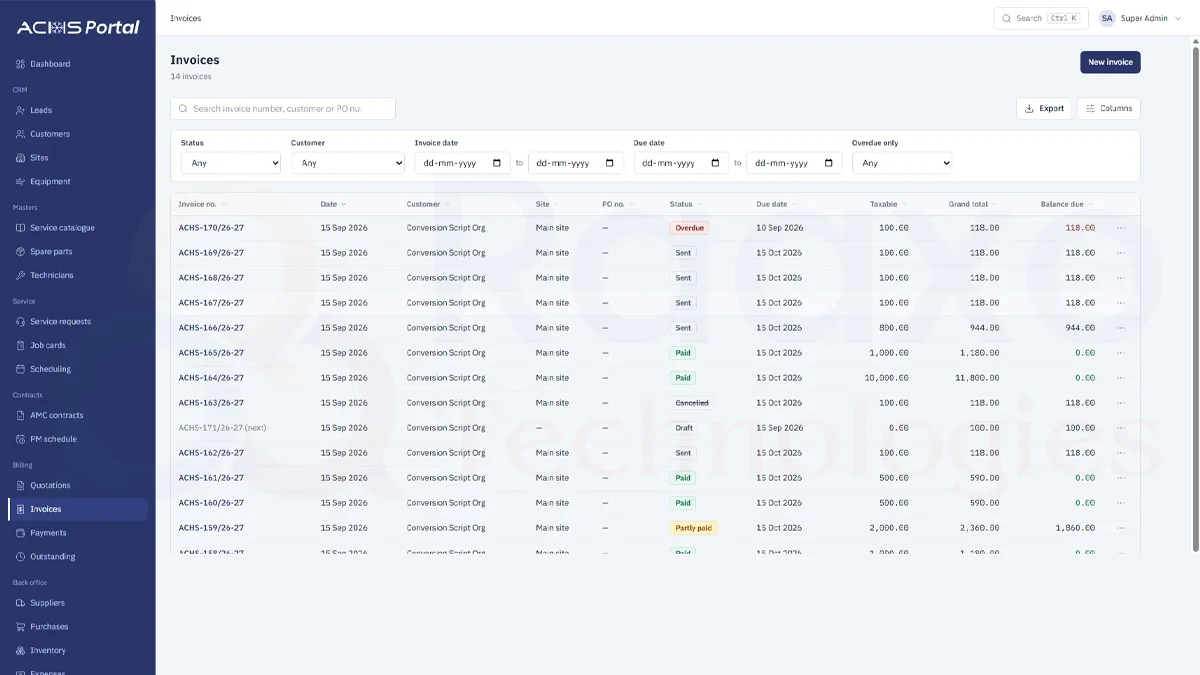
Invoicing with real-time payment status — Overdue, Sent, Paid, Partly paid, Cancelled all colour-coded at a glance. Balance due shown per invoice so nothing gets missed.
Most HVAC owners recognise this picture immediately: overdue invoices waiting without follow-up, sent invoices that nobody checked, and partly paid invoices with uncertain balances.
For a company handling many service calls, manual tracking means completed work may not become collected revenue. A proper billing module creates the invoice from the job record, shows its payment status, flags overdue amounts, and gives the owner one total outstanding figure.
Indian requirements matter here. GST-compliant invoice formats, correct HSN codes for parts and services, tax rates, and proper payment records cannot be an afterthought. The system should connect what happened at the site with what was quoted, invoiced, paid, and still owed.
What we are building for a Chennai HVAC company
We are currently building the ACHS Portal, a complete HVAC service management system for a Chennai-based HVAC company. It is real software for a real operation, not a demonstration screen.
The portal covers lead and customer management, customer sites, equipment registers, service and spare-parts catalogues, technicians, service requests, job cards, scheduling, AMC contracts, PM schedules, quotations, invoices, payments, suppliers, purchases, inventory, expenses, reports, users, permissions, and activity history.
It is built around how Indian HVAC companies actually work: GST billing, AMC structures, technicians using phones in the field, and WhatsApp remaining central to customer and team communication. The software works alongside WhatsApp instead of pretending every conversation will move to email.
This is custom software and ERP in practical terms: the workflow comes first, and the system follows it. Our EFS Portal ERP case study shows another field-service operation where one purpose-built system replaced scattered tools.
Off-the-shelf or custom-built: which is right?
Off-the-shelf HVAC software is faster to set up, costs less initially, and works well when your process is standard: receive a request, schedule a technician, track basic AMC dates, and invoice the customer.
The question is whether it fits Indian operations. Check GST support, WhatsApp integration, mobile use on ordinary Android phones, local support, AMC flexibility, and whether charges remain practical as your team grows.
Custom-built software makes sense when the business has specific complexity: multi-brand equipment records, different AMC visit frequencies, existing accounting connections, corporate job-card formats, multiple branches, or workflows that force too many workarounds in a standard tool.
Predictive maintenance means using equipment and service history to identify likely problems before failure. Businesses adopting it see 40% less downtime and 26% higher SLA compliance, according to McKinsey, cited in GetFieldy's 2026 HVAC software guide. SLA means Service Level Agreement — the promised response or completion standard agreed with a customer. Those gains only happen when staff consistently capture useful information in a system that fits their work.
Start with the simplest option that solves the real problem. Custom is not automatically better. But repeated workarounds are a sign that standard software no longer fits — a pattern also covered in how Indian businesses use custom software and why WhatsApp and Excel stop scaling.
Signs you need HVAC service management software in India
- You missed an AMC renewal because the date slipped through
- You spend more than 30 minutes each morning assigning technicians on WhatsApp
- You cannot immediately say which customers owe money and how much
- When a technician goes on leave, their job history and customer context go with them
- Spare-parts availability is unknown until someone calls from the site
- A customer complained because a PM visit did not happen on schedule
- Staff manually enter job details into an accounting tool or Excel afterwards
- You want to grow from 5 technicians to 15 but cannot see how coordination will work
If three of these feel familiar, the current method is already limiting profitability and growth.
Frequently asked questions
What is HVAC service management software?
It is a business system built for HVAC companies. It handles customer and equipment records, service scheduling, AMC contracts, technician job cards, spare parts, and invoicing in one place instead of across WhatsApp, Excel, notebooks, and separate tools.
How much does HVAC software cost in India?
Off-the-shelf tools typically cost ₹1,500–₹5,000 per user per month depending on features. Custom HVAC software is typically a one-time investment of ₹5L–₹20L+ depending on scope. Custom makes sense when standard tools require too many compromises in your actual process.
What is AMC management software, and do I need it?
It tracks contract dates, creates preventive-maintenance visits, assigns technicians, and warns you before renewals lapse. The clearest return is for businesses with 50 or more active AMC contracts, according to eBizIndia's 2026 guide. At that volume, manual tracking can contribute to the 15–25% AMC revenue leakage identified by AntMyERP's 2026 guide.
Can HVAC software integrate with WhatsApp?
Yes. Software designed for Indian businesses can use WhatsApp for technician job details, customer updates, and renewal reminders. WhatsApp remains the primary communication channel; integration is essential.
How long does implementation take?
Off-the-shelf tools can take days or weeks to set up. A custom system commonly takes 2–4 months, depending on complexity. FieldServicePro's 2026 guide reports that teams switching from manual tracking save 6–10 hours of admin work per week within the first month.
If you run an HVAC business in India and still manage service requests on WhatsApp and AMC contracts in Excel, it is worth having this conversation before the next missed renewal or overdue invoice. Tell us about your operation.
Raaxo Technologies builds custom service management software for field service businesses across India — from our base in Chennai. We build what fits your business, not the other way around. Tell us about your operation.