
Every Indian business owner who starts thinking about digital marketing hits the same decision: Google Ads vs SEO India — which one first? Most of the advice online is written by agencies selling one or the other. That means it is either biased toward Ads ("get leads immediately!") or biased toward SEO ("build long-term organic traffic!").
The honest answer is neither. It depends on where your business is, what your budget is, and what you need right now. This guide gives you that honest answer with real 2026 India costs and a clear decision framework — not a sales pitch.
What is each one, in plain language?
Before comparing Google Ads vs SEO for Indian businesses, it helps to know exactly what each one is.
Google Ads (also called PPC — Pay Per Click) means you pay Google to show your business at the top of search results when someone searches for a specific keyword. Every time someone clicks your ad, you pay a fee. The moment you stop paying, your ads disappear. You can be visible on Google within hours of setting up a campaign.
In India in 2026, the average cost per click (CPC — the fee you pay each time someone clicks) is ₹20–₹60 for most commercial keywords, with a 2026 average of ₹24 for Search campaigns, according to WebChanakya's 2026 Google Ads pricing guide for India and VGraple's 2026 India Ads cost analysis. Industry ranges vary widely: ₹5–₹50 for local services and e-commerce, and ₹100–₹600+ for finance, insurance, and B2B software.
SEO (Search Engine Optimisation) is the process of improving your website so it appears in Google's organic — meaning non-paid — results when someone searches for what you offer. There is no cost per click. Once you rank, the traffic is free. But it takes time: most Indian businesses see measurable improvement in 4–6 months and meaningful traffic growth in 9–12 months, according to Digifinity's 2026 SEO vs Google Ads guide for Indian businesses.
The investment is in the work — improving your website, creating content, building your site's credibility — not in paying Google directly. We cover the practical ranking playbook in how to get your business on the first page of Google in India.
The bridge and the road: how to think about both
Here is the simplest way to think about Google Ads vs SEO India.
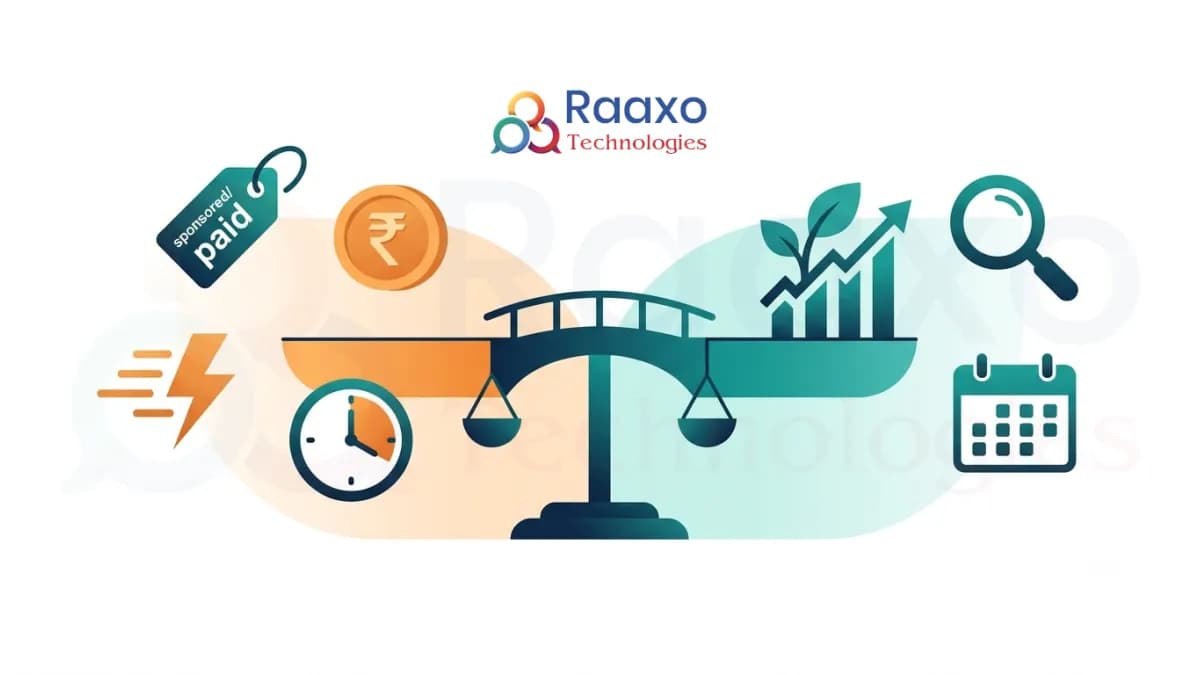
Google Ads is the bridge. It carries traffic to your business immediately while you are building your long-term presence. You pay for every car that crosses. The moment you stop paying, the bridge closes. Traffic stops the moment budget stops — that is how paid search works, as NicoDigital's 2026 Google Ads cost guide for India puts it.
SEO is the road. It takes 6–12 months to build. Once it is built, traffic flows for free indefinitely. Every rupee you spent building it keeps paying off. A ranked page generates clicks at near-zero marginal cost for years.
Google Ads traffic costs the same per click on year three as it did on day one. SEO traffic gets cheaper over time as your rankings strengthen and cost per visit drops toward zero. The businesses that scale profitably in India use paid search to generate demand today while building SEO to lower their cost of acquiring customers tomorrow.
Businesses combining both organic and paid search consistently outperform those relying on just one channel, according to Think with Google India research, cited in Digifinity's 2026 guide.
The real costs: what does each actually cost an Indian business?
This is the section most posts skip or get wrong. Plain numbers for 2026.
Google Ads costs:
- Average CPC: ₹20–₹60 for most commercial keywords (2026 Search campaign average: ₹24)
- Industry range: ₹5 for some local services and travel, up to ₹600+ for finance, insurance, and B2B SaaS
- Minimum monthly budget for meaningful results: ₹15,000–₹30,000 in media spend. Underinvesting — spending under ₹15,000 a month — is the most common mistake, according to VGraple's 2026 Google Ads budget guide for India. Google's Smart Bidding algorithms need roughly 30–50 conversions per month to exit the learning phase and start optimising properly; for new accounts, expect 4–6 weeks before campaigns stabilise (WebChanakya 2026)
- Agency management fee (if you hire someone to run it): typically ₹5,000–₹25,000/month extra
- Total realistic monthly investment for a small Indian business: ₹20,000–₹50,000
SEO costs:
- No cost per click — ever
- Investment is in the work: website improvements, content creation, technical fixes
- Done in-house: time — roughly 5–10 hours per week
- Done by an agency: typically ₹8,000–₹30,000/month depending on scope
- Timeline: 4–6 months to see first improvements, 9–12 months for meaningful traffic
- Long-term return: a page that ranks well generates leads for years at near-zero extra cost
The honest comparison: Ads costs more upfront and keeps costing. SEO costs more patience and delivers later — but compounds in your favour over time.
A manufacturer in Coimbatore or textile trader in Ahmedabad often finds local SEO cheaper and more durable than high-CPC Ads. A real estate or fintech business in Mumbai faces higher CPCs — which makes SEO even more valuable over three years.
Who should start with Google Ads?
Google Ads is the right first investment when:
- You are a new business with no organic presence — nobody knows you exist yet and you need leads now
- You are launching a new product or service and need to validate demand quickly
- You are in a seasonal business — wedding services in Jaipur, tourism around peak travel periods, accounting work around tax season — and need visibility during your window
- Your keyword competition is low enough that ₹15,000–₹30,000 a month generates enough clicks to matter
- Your website already converts visitors into enquiries
That last point is non-negotiable. If your website does not convert, fix it first. Sending paid traffic to a site that does not convert is burning money. We cover the conversion fixes in how to get more leads from your website in India, and why a weak site quietly destroys spend in why a cheap website costs more.
A logistics company in Delhi or an IT services firm in Chennai that needs pipeline this quarter often starts with Ads — then runs SEO in parallel so they are not forever dependent on paid clicks.
Who should start with SEO?
SEO is the right priority when:
- Buyers research before they contact — B2B manufacturers in Coimbatore, IT service businesses in Chennai or Bangalore, professional services (CA firms, consultants, lawyers)
- Your buying cycle is long — people compare options over weeks before deciding
- You want to reduce marketing cost over time, not increase it
- You can invest for 6–12 months before seeing full returns
- Your competition is not running aggressive Ads — still true in many Tier-2 cities and niche B2B markets in India, including parts of Hyderabad and Ahmedabad, where ranking organically is genuinely achievable
- You already have traffic but it is not converting — fixing SEO foundations plus conversion is more efficient than pouring Ads onto a broken website
Local SEO — appearing in Google Maps and "near me" results for your city — often delivers faster results than national SEO. A facility management company in Chennai or a gems trader in Jaipur can win local pack visibility with consistent Google Business Profile work and city-specific service pages. For ongoing SEO work, see our SEO and performance services.
The decision by stage of business
Apply this framework to where you are today.
Stage 1 — New business, new website (0–6 months old). Start with Google Ads for immediate visibility while building SEO foundations alongside. Your website has little authority yet — SEO will take longer. Use Ads to generate leads and learn which keywords your customers actually search. Run SEO from day one: the sooner you start, the sooner it compounds. For Chennai businesses building that foundation, web development in Chennai is often step one before either channel pays off.
Stage 2 — Established business, some online presence (6 months–2 years). Continue Ads on your highest-converting keywords. Accelerate SEO — you should start seeing organic movement. Track which Ads keywords generate the best leads, then create SEO content targeting those same keywords organically.
Stage 3 — Growing business with established SEO (2+ years). As organic rankings strengthen, reduce Ads spend on keywords where you already rank. Redirect that budget to new or competitive keywords where you have not established organic rankings yet. Over time, your blended cost of acquiring a customer falls.
A Bangalore e-commerce brand or Hyderabad pharma distributor in Stage 3 often spends less on Ads than they did in year one — not because they abandoned paid search, but because SEO started carrying the load on their best keywords.
The one thing that kills both strategies: a website that doesn't work
Both Google Ads and SEO send people to your website. If that website loads slowly on a budget Android phone, has no WhatsApp button, no clear call to action, or no trust signals — you will waste every rupee spent on either strategy.
A Chennai facility management company with a fast, mobile-ready website and a clear WhatsApp button will convert far more paid and organic traffic than one with a slow, generic site. Speed matters — we explained why in why your business website needs to load fast.
Before spending on Ads or SEO, make sure your website converts. A cheap site that fails on mobile quietly kills both channels — see why a cheap website costs more.
The honest answer: use both, in the right order
The debate is a false choice. The right question is not "Google Ads or SEO?" — it is "what do I need right now, and what am I building toward?"
For most Indian businesses in 2026: start with both. Use Google Ads to generate leads today. Invest in SEO to reduce what you pay for those leads tomorrow. Run Ads heavily in the first 6–12 months while SEO builds. As organic rankings grow, reduce Ads spending on those keywords and redeploy the budget elsewhere.
Within 18–24 months, a well-run combined strategy typically delivers a lower blended cost per lead than either channel alone. For the broader growth sequence around this decision, see how to grow your business online in India.
Frequently asked questions
Is Google Ads or SEO better for Indian businesses in 2026?
Neither is universally better. Google Ads delivers immediate results but stops when budget stops. SEO takes 6–12 months but delivers compounding, free traffic over years. The most effective strategy for Indian businesses is to run both: use Google Ads for immediate lead flow while SEO builds in the background, then gradually reduce Ads spend on keywords where you start ranking organically.
How much does Google Ads cost for a small business in India?
In 2026, the average cost per click in India is ₹20–₹60 for most commercial keywords, according to WebChanakya and VGraple. A meaningful minimum monthly budget is ₹15,000–₹30,000 in ad spend. Total monthly investment including management typically ranges from ₹20,000–₹50,000. Underinvesting under ₹15,000 a month is the most common mistake — the algorithm needs enough data to optimise properly.
How long does SEO take to work for Indian businesses?
Most Indian businesses see measurable improvements in 4–6 months and meaningful traffic and lead growth in 9–12 months, according to Digifinity's 2026 guide. Local SEO — appearing in Google Maps results for your city — can show results faster, sometimes within 2–3 months, because local competition is often less intense.
Should I run Google Ads if my website is not very good?
No. Sending paid traffic to a website that does not convert is burning money. Before running Ads, ensure your website loads fast on mobile, has a clear WhatsApp button and call to action, and looks professional enough to earn trust. Fix the website first — even a modest improvement in conversion rate makes your Ads significantly more profitable. See how to get more leads from your website in India.
Can a small business in India do SEO without an agency?
Yes, for the basics. Claiming and optimising your Google Business Profile, creating service pages with city-specific keywords, and publishing regular helpful content are things a business owner can do without technical expertise. More advanced SEO — technical website optimisation, backlink building, structured data — typically benefits from professional help. Start with the basics and expand as results justify the investment.
If you are trying to decide between Google Ads and SEO for your business — or want to understand what the right starting budget and timeline looks like for your industry and city — that is a conversation worth having before you spend anything. Tell us about your business.
Raaxo Technologies builds SEO-ready websites and helps businesses across India get found online — from our base in Chennai. We build the digital foundation that makes both Ads and SEO work. Tell us about your business.