
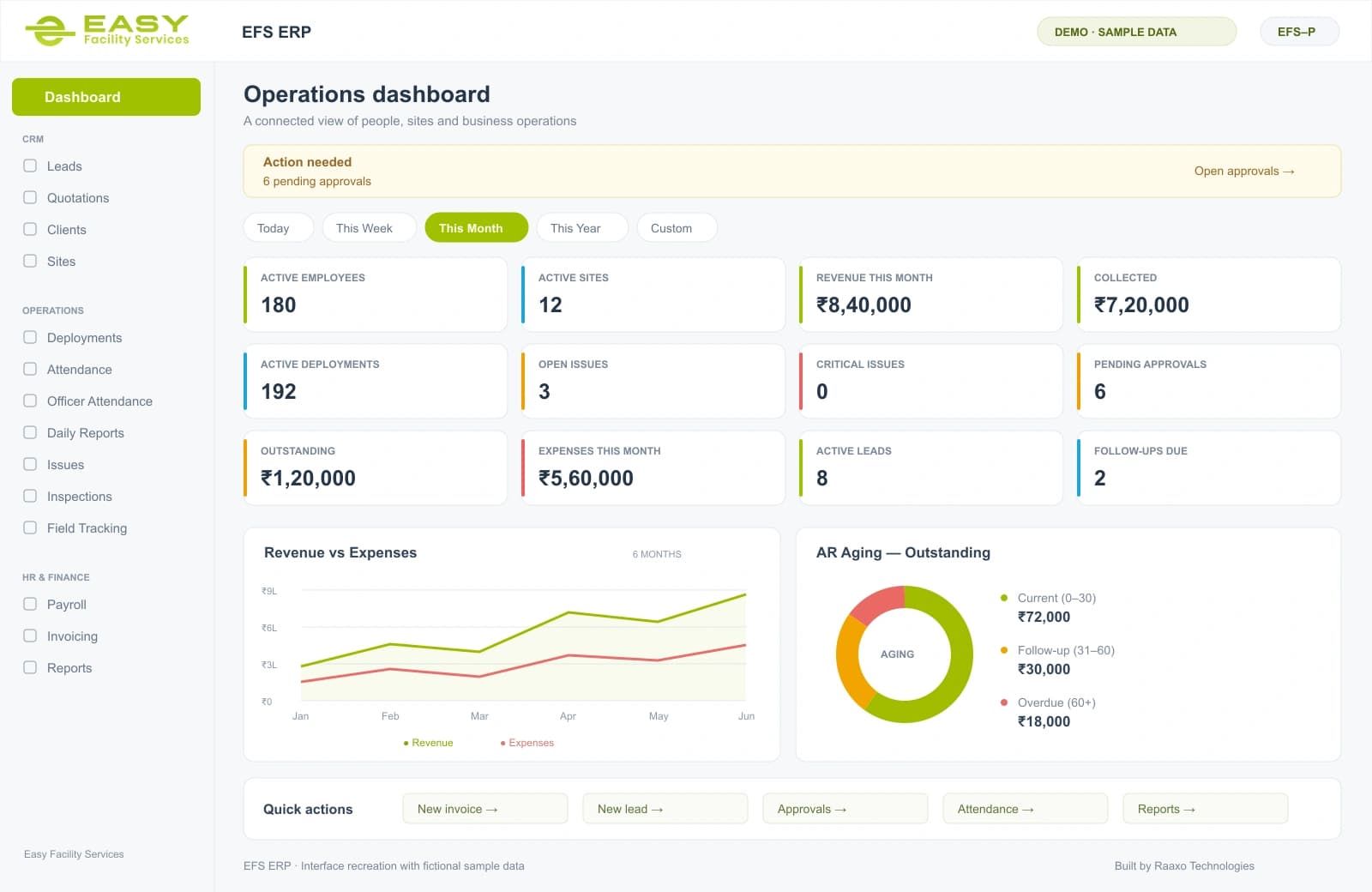

Facility management · Chennai
EFS Portal
Built by Raaxo. Run by EFS. Daily.
Attendance, payroll, field operations, client management, invoicing and compliance in one ERP that EFS uses daily.
Build · ERP Software Development
When your business runs on a tangle of spreadsheets, WhatsApp messages, and software that almost fits, you feel it every single day — the double entry, the things that slip through, the sense that no one has the full picture. We build software that ends that. One system, shaped around how your business actually works.
Built for a real business
Delivered systems, the workflows they connect and the businesses they were built for.
Facility management · Chennai
Built by Raaxo. Run by EFS. Daily.
Attendance, payroll, field operations, client management, invoicing and compliance in one ERP that EFS uses daily.
 BaskarDirector, Easy Facility Services
Raaxo built our ERP and company website together. Having one team handle both meant our operations platform and online presence were built to work in the same direction — and they understood facility services without us having to explain it from scratch.
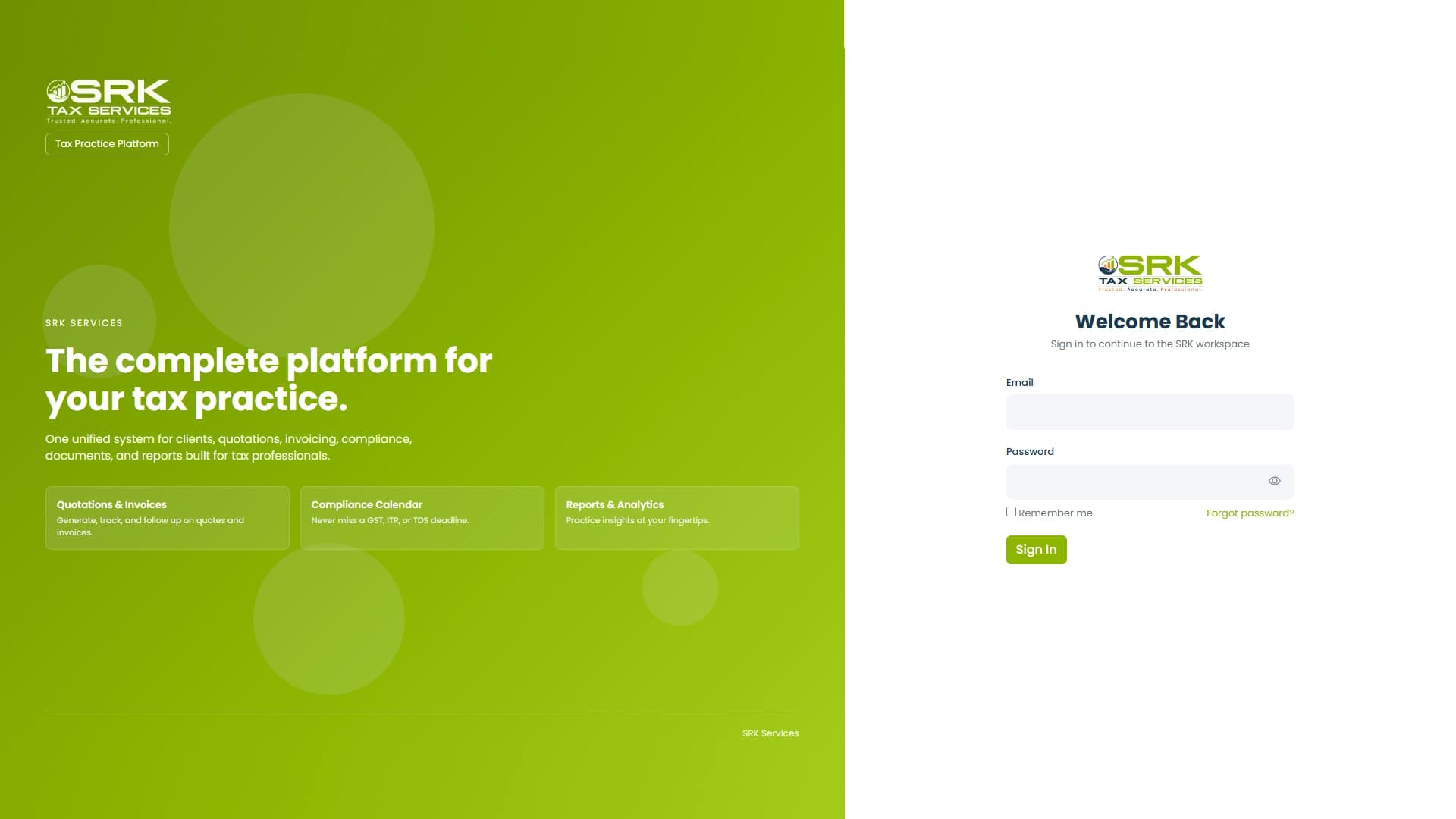

Tax & professional services · Chennai
A workspace built around a tax practice.
Client records, quotations, invoices, compliance work, documents and reports brought into one practice management platform.
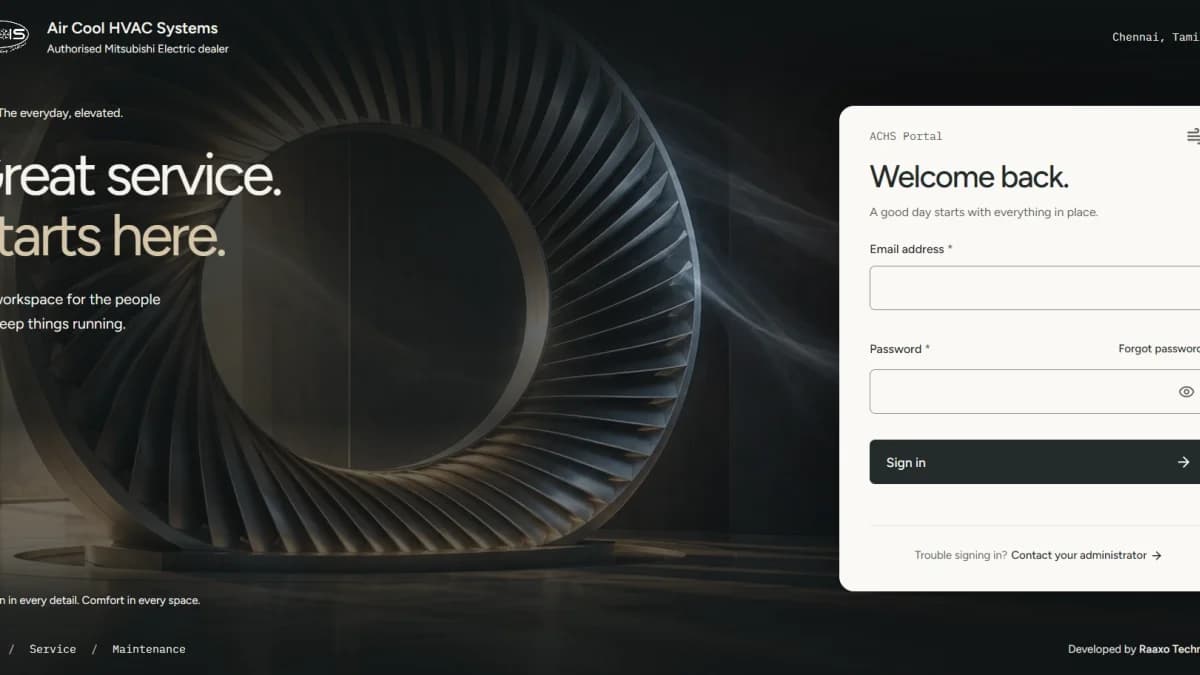

HVAC & field service · Chennai
Service work, connected from request to invoice.
Leads, AMC contracts, job cards, technician scheduling, invoicing and payments connected in a custom HVAC service management portal.
The problem we solve
Most service businesses — facility management companies, professional firms, field service operations — reach a point where the work is there but the visibility isn't. Attendance is on WhatsApp. Invoices are in Tally. Client records are in Excel. Payroll is a monthly reconciliation exercise. Nothing talks to anything else, and the owner spends Monday morning chasing five departments for numbers that should already be visible.
Zoho, SAP Business One, and Tally work well for the businesses they were designed for. The challenge for Indian service businesses is that their operations — multi-site deployment, contract-based billing, attendance across client locations, manpower compliance — rarely fit the standard templates. Customising a packaged ERP to fit an unusual workflow costs more, takes longer, and often produces a system the team works around rather than with.
Built by Raaxo. Run by EFS. Daily. Raaxo built the complete ERP for Easy Facility Services, a Chennai-based facility management company. EFS uses it daily for attendance, payroll, field operations, client management, invoicing and compliance. Our work is grounded in an active operator’s understanding of the business problems the system solves. We work with businesses across Chennai and Tamil Nadu, meeting you at your premises by appointment, and with clients elsewhere in India remotely.
The right starting point is rarely a full system on day one. It is the module costing the most time or money right now — often invoicing, or payroll, or client management. The system grows from there, shaped around how the business actually works.
An example of how the work connects
Illustrative flow · Exact steps and approvals agreed during discovery.
What we can build together
Choose the work that solves the problem. Your proposal defines the deliverables, integrations and responsibilities included.
HR and payroll — employee records, attendance, leave, salary structures, PF and ESI, payslips and registers
Quotations and invoicing — raise quotes, convert to invoices, track payments, flag overdue, generate GST-compliant documents
Client and contract management — client records, contracts, billing terms, renewal tracking, multi-site visibility
Inventory and purchases — stock levels, purchase orders, supplier management, low-stock alerts
Field operations — job cards, technician dispatch, service scheduling, completion tracking, site reports
Dashboards and reports — real-time business overview, revenue, outstanding, headcount, operational metrics
Role-based access — each team member sees only what their role requires; directors, HR, operations and accounts all work from the same system
Code ownership — clients who want it own the software and the code outright, under NDA
Who it’s for
Before you commit
The practical decisions belong in the open. Discuss these before settling the scope and quote.
Agree on the first module, the people using it and the reports it must produce before expanding the system.
Identify spreadsheets and existing systems, clean the source data, and agree how imported totals will be checked.
Separate development from hosting, third-party services and ongoing support. Define ownership and access in the agreement.
Deliverables and review stages. Data and account access. Ownership and third-party fees. Handover, training and post-launch support. Agree what is included and what is separate.
How we work together
You work with the people doing the work. Scope, reviews and handover are part of the conversation from the beginning.
Map the current process, the people involved and what needs to improve.
A clear scope and prioritiesReview the direction and key flows before committing to implementation.
An agreed directionReview work at each stage, resolve questions early and check it against the scope.
Work you can reviewPrepare the documentation and training your team needs. Agree the support arrangements.
A handover your team can useStart with the module costing the most time or money right now. For most service businesses that is invoicing, payroll, or client management. We scope that first, build it properly, and the system grows from there. You do not need to commit to a full ERP to start. A narrower brief is custom software beyond ERP.
It fits your process. Before any code is written, we map how your team actually works — the forms you use, the approval steps, the reports you need. The software is built around that, not the other way around.
Packaged ERP works well for standard workflows. The challenge for Indian service businesses is that multi-site deployment, contract billing, attendance across client locations, and manpower compliance rarely fit the standard templates. When the business spends more time working around the software than using it, custom is the right answer. When a packaged tool genuinely fits, we will say so.
The main factors are scope (how many modules), complexity (how many integrations, how unusual the workflow), number of users, and whether data needs to be migrated from existing systems. A focused first module — invoicing or payroll — is a fraction of the cost of a full system. We scope in detail before quoting, so there are no surprises. Our pricing page explains what shapes the investment.
Four stages: Discovery (we map your workflow and agree on scope), Design (screens and flows, reviewed before development starts), Build (iterative — you see working software early, not at the end), and Launch with handover and training. Most projects start showing working modules within the first few weeks.
All work is under NDA. Clients who pay for ownership own the software and the code outright — it is not hosted on a Raaxo platform or dependent on a Raaxo subscription. Your data stays on your infrastructure.
Usually yes — Tally, WhatsApp Business API, payment gateways, GST portals, and most tools with an API. We recommend integrations only where they genuinely reduce work. Where replacing a tool is the cleaner long-term path, we will say that too.
Raaxo built the ERP that Easy Facility Services uses daily for attendance, payroll, field operations, invoicing and compliance. Read the full EFS Portal story. We also built SRK Services’ CRM and practice management platform and the HVAC service management portal for Air Cool HVAC Systems. The project evidence on this page explains the delivered scope.
Let’s talk · ERP Software Development
Bring the process, the problem or the idea. We’ll discuss what needs to change, what can stay, and the right first step.
No finished specification needed. Start with a conversation.