
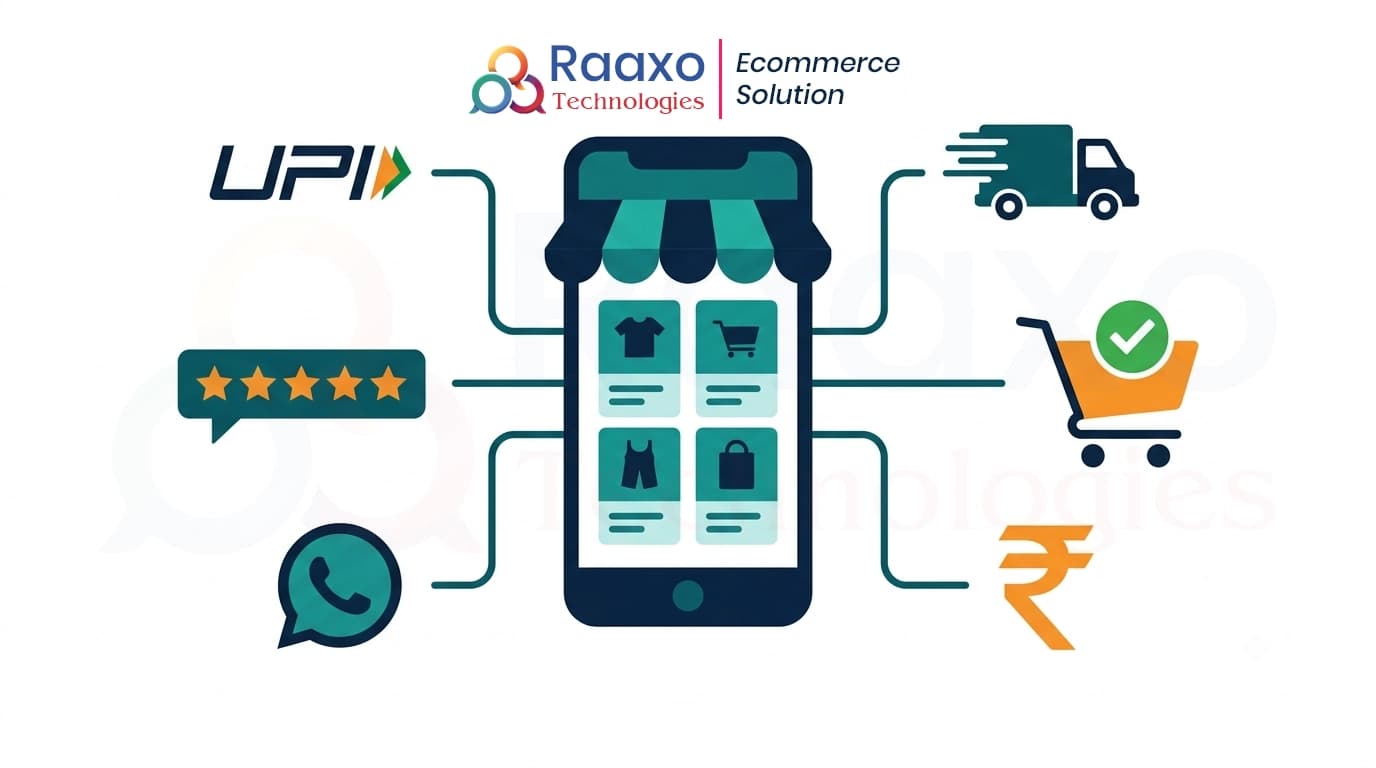
India now has 290–300 million online shoppers — the third-largest buyer base in the world after China and the US, according to TapWell's 2026 India e-commerce statistics. Online retail sales are projected to reach $120 billion by 2026, per the IBEF India e-commerce industry report 2026. The opportunity is enormous.
And yet the average e-commerce conversion rate in India is just 1–2%, according to Shopaccino's 2026 India e-commerce conversion guide — meaning for every 100 people who visit a typical Indian store, only one or two buy. Cart abandonment hovers at 65–75%, per Dreams Technologies' 2026 e-commerce features guide. Most people who add something to the cart never complete the purchase.
Most Indian ecommerce website India stores are not converting because they were not built for how Indian shoppers actually behave. This guide covers the features, payment options, and trust signals that turn visitors into sales — not just page views.
First: understand how Indian shoppers actually behave online
Before features, context. 82% of Indian e-commerce transactions happen on mobile devices, according to Growzai's 2026 India e-commerce data — often on a ₹10,000 Android phone with inconsistent 4G. 50% of new e-commerce orders now come from Tier 2 and Tier 3 cities, per SaaSUltra's 2026 India e-commerce statistics — places like Surat, Coimbatore, Patna, and Indore, where trust thresholds are different and cash on delivery is still preferred.
Indian shoppers research before they buy. They read reviews, check WhatsApp groups, and compare sites. They abandon carts the moment checkout feels complicated. They do not trust a store with no social proof. They want to pay their way — UPI, COD, EMI — not whatever is most convenient for the merchant.
A jewellery seller in Jaipur, a textile trader in Surat, and a fashion brand in Mumbai face the same buyer behaviour in different forms. Building for India means building for this reality, not for a hypothetical global shopper on a MacBook.
Feature 1: Mobile speed and performance (the single most impactful thing)
82% of Indian e-commerce transactions happen on mobile. Your site must load in under three seconds on a budget Android phone on 4G — not just on fibre broadband. Every 1-second delay in page load can drop conversions by 7–20%, according to Dreams Technologies' 2026 e-commerce features guide.
In practice that means: compressed product images (ideally under 100KB each), minimal scripts, no unnecessary animations, and hosting that serves Indian visitors quickly. A beautifully designed store that takes eight seconds on a Redmi will lose almost every sale to a simpler store that loads in two.
This is the single highest-ROI improvement for most Indian e-commerce sites that are not converting — not more products, not better ads, not a redesign. Faster loading. We explained why speed matters more broadly in why your business website needs to load fast. A cheap, slow theme often quietly destroys sales before marketing can help — see why a cheap website costs more.
Feature 2: Payment options Indian shoppers actually use
UPI accounts for approximately 60–65% of all online e-commerce transactions in India — Google Pay, PhonePe, and Paytm are how most shoppers prefer to pay, according to SaaSUltra's 2026 India e-commerce statistics. If your store does not support UPI natively, you lose the majority of potential buyers at checkout.
COD (Cash on Delivery) still accounts for 25–30% of orders, especially in Tier 2 and Tier 3 cities and among first-time online buyers who do not yet trust digital payments. EMI and buy-now-pay-later options matter for higher-ticket items. Net banking and debit cards still matter for older shoppers.
Practical checklist: use a gateway such as Razorpay or Cashfree that covers the full Indian payment mix; enable COD and make it configurable by pincode; show all accepted methods on the product page — not only at the last checkout step. A textiles seller in Coimbatore shipping to Tier 2 towns will convert differently from a lifestyle brand in Bangalore — but both still need UPI first and COD as a trust bridge for first-time buyers.
Feature 3: Product pages that convert (not just display)
Most Indian product pages show a photo, a price, and a buy button. The ones that convert show more.
Multiple photos from multiple angles. Indian shoppers inspect images carefully. Aim for at least 4–6 photos per product. Add a short video where it helps — jewellery in Jaipur, textiles in Coimbatore, or lifestyle products in Bangalore.
Size guide or specification table. For fashion, electronics, and home goods, clear specs remove the uncertainty that causes abandonment.
Reviews with photos. Reviews and free shipping are the strongest conversion drivers for Indian online shoppers, according to Growzai's 2026 India e-commerce data. Show the star rating and review count prominently. Photo reviews convert far better than text alone.
Delivery date estimate. "Delivery by [date]" on the product page — not only at checkout. Shoppers want to know before they add to cart.
Pincode check. "Check delivery to your area" with a pincode field. Critical for Tier 2 and Tier 3 cities where delivery is not guaranteed everywhere.
WhatsApp enquiry button. For higher-ticket or complex products, "WhatsApp us about this product" matches how Indian buyers actually ask questions.
Stock status. "Only 3 left" creates urgency. "In stock" reduces anxiety.
Feature 4: Trust signals that Indian shoppers look for
First-time buyers on a new store are cautious — especially in Chennai handicrafts, Delhi fashion, or Mumbai beauty brands that shoppers have never heard of. Trust signals tell them this is a real business that will deliver.
Google reviews or ratings displayed prominently.
Customer photos — real buyers using or wearing the product convert better than studio shots alone.
Clear return or exchange policy on every product page. "7-day no-questions return" removes the biggest fear: what if it is wrong?
Secure payment badges — SSL padlock, Razorpay or Cashfree logo, "100% Secure Checkout." Visual reassurance works.
About us with real details — a founder photo, a real address, a real phone number. Indian buyers respond to knowing who is behind the brand. The same conversion principles apply beyond ecommerce; see how to get more leads from your website in India.
Visible WhatsApp contact — for many Indian shoppers, knowing they can message you is the deciding factor.
Feature 5: Checkout that doesn't leak sales
Cart abandonment in India is 65–75%. Most people who add to cart never buy. Common reasons: checkout is too long, payment fails, unexpected shipping cost, or trust collapses at the payment step.
What reduces abandonment for Indian stores:
Guest checkout. Never force account creation before purchase. Every extra step loses buyers.
Single-page or short checkout. The fewer screens between "add to cart" and "order confirmed," the better.
Show total cost early. Surprise shipping charges at the last step kill sales. Show the full price — including shipping — from the product page or cart.
COD shown clearly. For Tier 2 and Tier 3 buyers, knowing COD is available before checkout reduces abandonment.
Pre-filled details for returning customers. Less friction for people who buy again.
Prepaid order incentive. Offer ₹30–₹50 off or free shipping for prepaid orders (UPI or card). This matters for three reasons: it reduces COD volume, which improves cash flow; it lowers RTO (Return to Origin) rates — when a COD order is refused or never collected and comes back to you at your cost; and it rewards buyers who are ready to pay. Most profitable Indian D2C brands use some version of this incentive.
Feature 6: WhatsApp integration (non-optional for Indian ecommerce)
WhatsApp is where many Indian buying decisions happen. On an ecommerce website India store, it should work at multiple points — not as a single chat icon buried in the footer.
On the product page — for pre-purchase questions about size, fabric, shipping, or authenticity.
At order confirmation — WhatsApp updates convert better than email for many Indian buyers.
For cart recovery — a personal WhatsApp message recovers more abandoned carts than most automated email sequences.
For post-purchase support — delivery questions, exchanges, and "where is my order?" conversations.
A shopper who gets a WhatsApp message from a brand feels they are dealing with a real business, not an anonymous website. Relative to its cost, this integration often has one of the highest conversion impacts of any feature on an Indian store — especially for handicrafts, jewellery, and made-to-order products where buyers want reassurance before they pay.
Feature 7: SEO and discoverability (how new customers find you)
Great features without traffic do not generate sales. For Indian ecommerce, discoverability means product pages written for how people search — "handloom cotton saree Chennai," "organic ghee online India," "copper water bottle Coimbatore" — not internal SKU names. "Handcrafted mango wood serving tray" can rank; "SKU-4472 Kitchen Series" will not.
Add Google Shopping Basic listings where relevant (free in India), and build category pages around how buyers think, not how your warehouse is organised. For traffic strategy — organic versus paid — see Google Ads vs SEO for Indian businesses and our SEO services.
Platform choice: template, Shopify, or custom?
This is where many Indian businesses overthink. For standard products and a straightforward catalogue, Shopify or WooCommerce configured properly by an experienced developer can deliver everything above. For a complex catalogue, B2B pricing, custom workflows, or ERP and multi-warehouse needs, a custom platform built around your process often delivers better long-term results.
The wrong question is "which platform is cheapest?" The right question is "which platform, configured for Indian shoppers, will convert the most visitors for my product category?" We cover platform choice in depth in readymade e-commerce template vs custom development. When you are ready to build, see our e-commerce development and web development services.
The checklist: what a selling ecommerce website India needs
Use this as a practical audit of your store — or of a quote you are about to accept:
✅ Loads in under 3 seconds on mobile
✅ UPI payment (Google Pay, PhonePe, Paytm) natively supported
✅ COD available, configurable by pincode
✅ Product pages with 4+ images, reviews with photos, delivery date, pincode check
✅ WhatsApp button on product pages and at checkout
✅ Guest checkout — no forced account creation
✅ Total cost visible before checkout (no surprise shipping)
✅ Prepaid order incentive (discount or free shipping)
✅ Clear return/exchange policy on every product page
✅ Real trust signals: Google reviews, founder story, real address
✅ Product page SEO: optimised for how buyers search, not internal SKUs
✅ GST-compliant invoice generation for every order
If half of these are missing, fixing the store usually beats spending more on ads. For the wider growth sequence around traffic, systems, and conversion, see how to grow your business online in India.
Frequently asked questions
How much does it cost to build an e-commerce website in India?
A basic Shopify or WooCommerce store set up by a developer typically costs ₹30,000–₹80,000 to launch. A professionally designed store optimised for Indian shoppers often costs ₹80,000–₹2,50,000. A custom platform with specific features usually starts from ₹3L–₹10L+ depending on scope. The cost of a site that does not convert is almost always higher than building it properly the first time.
What payment options should my Indian e-commerce site support?
UPI (Google Pay, PhonePe, Paytm) is essential — it accounts for 60–65% of Indian e-commerce transactions, according to SaaSUltra's 2026 statistics. COD remains important for Tier 2 and Tier 3 cities and first-time buyers (25–30% of orders). Add credit and debit cards, net banking, and at least one buy-now-pay-later option for higher-ticket items. Razorpay and Cashfree both cover the full range.
Why is my e-commerce website getting visitors but no sales?
The most common causes in India: the site loads too slowly on mobile (every 1-second delay can drop conversions 7–20%), no COD for Tier 2 and Tier 3 shoppers, no WhatsApp button for pre-purchase questions, no reviews or trust signals, and checkout with too many steps. Fix mobile speed and add reviews first — those two changes alone improve conversion for many underperforming stores. See also how to get more leads from your website in India.
Do I need a custom e-commerce website or is Shopify enough?
For most product businesses with a standard catalogue, Shopify or WooCommerce configured correctly is enough. Custom development makes sense when your catalogue is complex, you need B2B pricing, multi-warehouse inventory, ERP integration, or workflows that standard platforms cannot handle without heavy workarounds. Start with the platform that fits your current scale — not the one you might need in five years.
How do I increase sales on my existing e-commerce website?
In order of impact: improve mobile page speed, add product reviews and photos, make COD available, add WhatsApp on product pages, simplify checkout, and offer a prepaid order incentive. The average Indian e-commerce conversion rate is 1–2% (Shopaccino 2026) — most stores can grow sales from the same traffic by fixing these basics before spending more on ads.
If you are planning an ecommerce website in India — or want to understand why your existing store is not converting — that is exactly the conversation to start. Tell us about your product and your customers.
Raaxo Technologies builds e-commerce websites for Indian businesses — from our base in Chennai. We build for how Indian shoppers actually buy, not for how Western platforms were designed. Tell us about your product and your customers.