
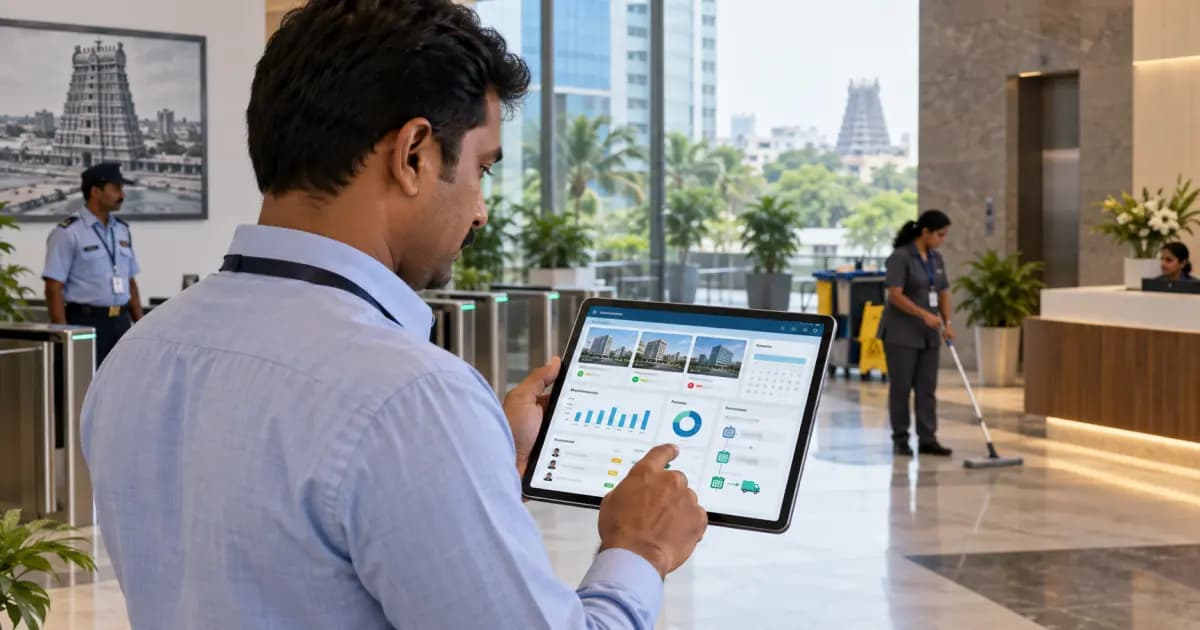
A facility management company managing 15 client sites runs on four things: WhatsApp groups, Excel attendance sheets, a billing file, and one person who holds all of it together. When that person is on leave, or when the company wins its 16th client, the whole system shows its cracks.
This is not a software problem in isolation. It is a growth problem that software can help solve — but only if the software is built around how FM operations actually work, not how a generic platform assumes they work.
This article explains what the breaking point looks like for most FM businesses, what a purpose-built system covers, and what to expect from the decision between spreadsheets, off-the-shelf tools, and a custom build.
How most FM companies currently operate
The pattern is consistent across companies managing anywhere from five to fifty client sites.
Attendance runs on WhatsApp. Supervisors send morning photos of their muster or type head counts into a group. An operations coordinator — usually one person — collects this across all sites, copies it into Excel, and reconciles it at the end of the month for payroll. If a site sends late, the coordinator chases. If a number is wrong, it surfaces during salary processing.
Deployment is managed by phone. A client reports an absence or requests a replacement. The coordinator checks who is available — from memory or a separate roster sheet — and arranges cover. The client gets a callback. Nothing is logged automatically.
Billing is built from the attendance Excel. At the end of the month, someone maps actual attendance to contract rates, calculates deductions, and prepares the invoice. If the attendance data has errors from the month's WhatsApp collection, they appear here — as invoice disputes, delayed approvals, or the client pushing back on the numbers.
Contracts and renewals sit in a folder or a single tracking sheet. Renewal follow-ups happen when someone remembers.
This works. Until it doesn't.
Where the system breaks
The breaking point is not always the number of sites. It is the volume of attendance exceptions, replacements, client-specific requirements, approvals, and reconciliations that the operations team must handle. A business managing ten sites with complex contracts, high staff turnover, and demanding clients may hit this ceiling earlier than a business managing twenty with stable contracts and a consistent workforce.
The cracks appear in predictable places:
Payroll disputes become routine. When attendance data is assembled manually from WhatsApp messages, errors accumulate. Each dispute takes time to resolve and erodes client trust.
A key person leaves or is unavailable. The coordinator who knows where everything is, who covers which site, and how the billing works — when that person is absent, the company discovers how much institutional knowledge was never written down.
Clients start asking for documentation. Larger clients begin requesting deployment reports, attendance summaries, and audit trails. These cannot be produced from WhatsApp and Excel without significant manual effort.
A new contract arrives with compliance requirements. Some clients — corporates, hospitals, or government-linked facilities — require documented attendance records, duty rosters, and insurance compliance. This is difficult to demonstrate reliably from a manual system at scale.
Replacements create cascading paperwork. This is where the real cost of a disconnected system becomes visible.
How one absent employee affects four departments
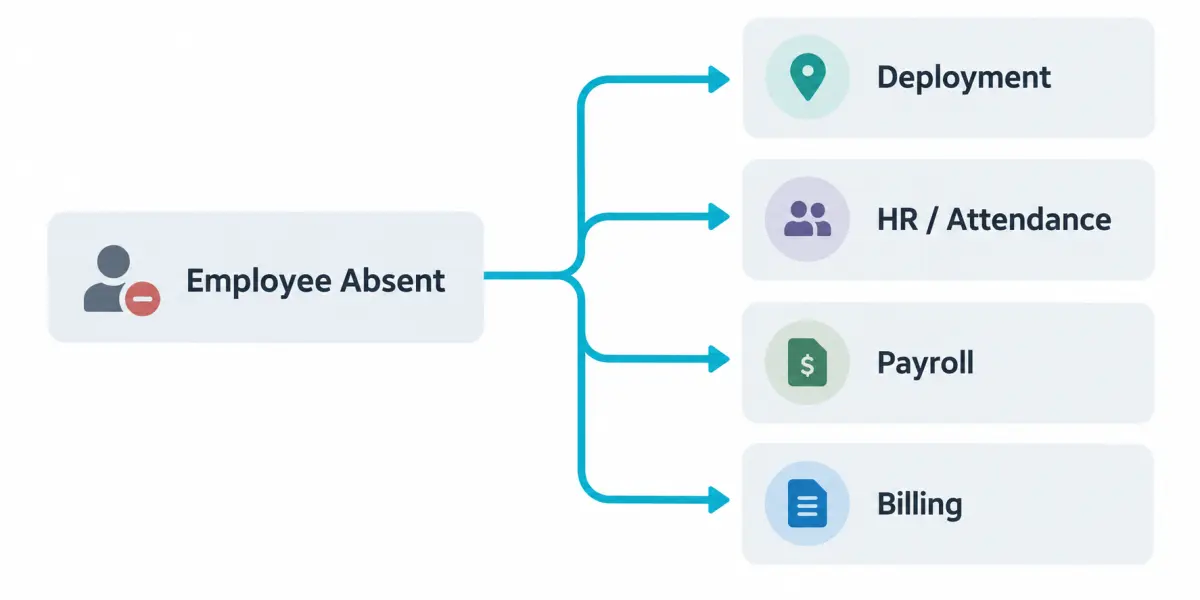 One absent employee, four departments affected — deployment, HR/attendance, payroll, and client billing all need updating from the same event.
Consider a routine scenario: a housekeeping employee does not show up for the morning shift.
In a disconnected system, this single event requires updates across multiple places:
- The field supervisor arranges a replacement and notifies the operations coordinator by phone or WhatsApp.
- The operations coordinator updates a deployment sheet — or makes a note to update it later.
- HR needs to record the original employee's absence and verify the replacement's attendance separately.
- Payroll must account for the original employee's deduction and the replacement's day rate, which may differ.
- Billing must confirm whether the contractual manpower requirement was met for that site and that day.
If these five steps happen across five separate sheets and conversations, the risk of one being missed or recorded incorrectly is high. When it is missed, it surfaces during month-end payroll or when the client reviews their invoice.
In a connected system, each step creates an auditable record of the same operational event — accessible to operations, HR, payroll, and billing from a single source.
This is not a hypothetical scenario. It is a daily occurrence in any FM business managing multiple sites, and it illustrates why module integration matters more than any individual feature.
What a purpose-built FM system is designed to handle
A software system built for FM operations addresses each point in the existing workflow — not by replacing people, but by reducing the dependency on any one person's attention and memory.
Attendance Supervisors mark attendance directly in an app — by site, by shift, by employee. Records are timestamped and synced to a central system. The operations team can view attendance across sites without calling anyone. Month-end payroll can be calculated from this verified data rather than from WhatsApp messages manually compiled into Excel.
Deployment and roster management Replacement requests are logged in the system. The coordinator can see which employees are available for which sites, based on skills, contract requirements, and current assignments. Deployment decisions are recorded. Clients can be given portal access to view their site's current deployment status.
How attendance connects to payroll and client billing
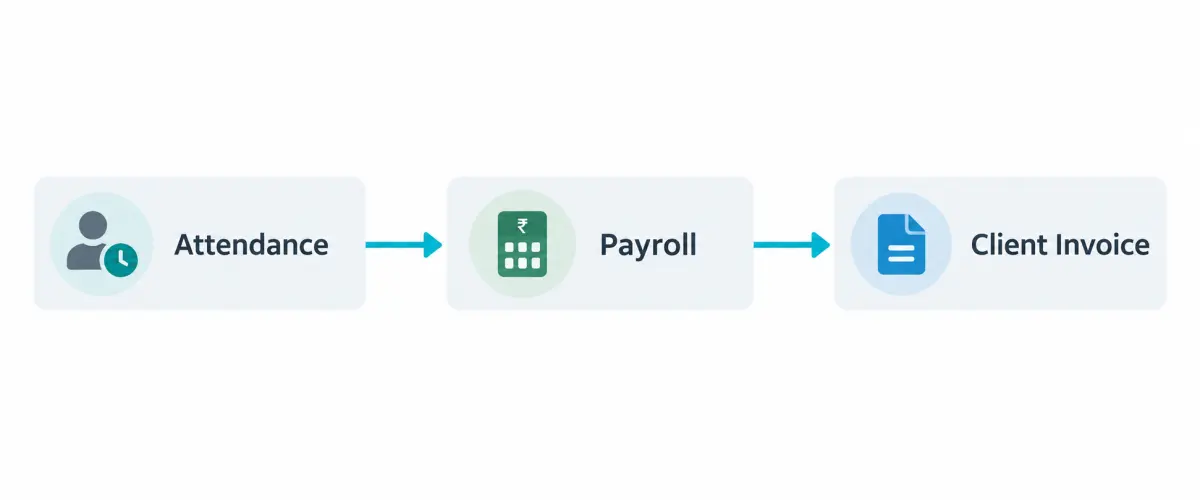 Attendance data flows into payroll calculation, then into client billing — three steps from the same verified source, reducing the need for separate reconciliation.
This is the part that most generic field-service platforms do not handle well for Indian FM businesses, and it is worth explaining specifically.
Attendance data — once verified — can feed into payroll calculation. The system applies CTC structure, leave rules, deductions, and applicable statutory contribution schedules. This reduces repeated data entry and makes exceptions easier to investigate. The actual time and effort saved depends on data accuracy, payroll configuration, the complexity of each employment arrangement, and the team's review process. The system supports the workflow; the team still reviews and approves before salaries are processed.
For client billing, invoices are generated from the same verified attendance data. Contract rates, shortfall deductions, and agreed adjustments are applied. The billing team reviews before anything is sent. When attendance records and invoice numbers come from the same source, disputes are easier to resolve — because both sides can trace the numbers back to the same data.
Statutory compliance A well-built payroll module can support PF and ESIC workflows, generate relevant documentation, and maintain records required for compliance purposes. It does not remove the employer's statutory obligations or replace professional payroll and compliance expertise. Configuration, employee eligibility, current legal requirements, and verification remain the business's responsibility.
Contracts and renewals Contract terms, renewal dates, and escalation clauses are stored in the system. Alerts trigger ahead of renewal deadlines.
Reporting Attendance summaries, deployment history, and billing reports can be pulled by site, client, or time period — without asking the coordinator to compile them manually.
The honest comparison: what are the options?
Continue with Excel and WhatsApp A reasonable choice if the operations are manageable at current scale, the team is stable, and clients are not requesting compliance documentation. The model has a ceiling, but it is not wrong for every stage of growth.
Improve the spreadsheet system Better templates, shared Google Sheets, and clearer WhatsApp protocols can buy time. This addresses the discipline problem, not the data-collection and reconciliation problem.
Off-the-shelf software — understanding the categories There are three distinct types of software relevant to an FM business:
Field-service systems (Zoho FSM, ServiceMax, FieldAware) are built for technician dispatch, job tracking, and maintenance contracts. They work well for break-fix and AMC workflows. They are generally not built for manpower-intensive FM operations involving daily muster, roster management, or Indian CTC-based payroll.
Workforce management tools handle attendance, rostering, and basic payroll. These may cover part of the requirement. The gap is often integration — attendance, billing, and contracts sitting in separate systems that do not talk to each other.
Integrated FM ERP platforms combine operations, HR, billing, and contracts. Some Indian vendors offer these. The question is always whether the platform's configuration covers your specific workflow, contract structure, and reporting requirements — or whether it requires the same manual workarounds you have now, just in different software.
Custom software is one option, not the predetermined answer. The right choice depends on where the current system is breaking, what off-the-shelf options actually cover, and whether the cost of a build is recoverable at your current and projected scale.
Custom build The right fit when the workflow is specific enough that no existing platform covers it without significant compromise, and when the business is at a scale where the cost of the build is justified by the operational and commercial value of getting it right. The decision to build should come after honestly assessing what available platforms can and cannot do for your specific operation.
Raaxo's experience with FM operations software
Raaxo Technologies developed an operational ERP platform for Easy Facility Services, a facility management business managing multiple client sites in Tamil Nadu. The EFS Portal case study covers the scope in detail — attendance, deployment, payroll, client billing, and reporting, built around EFS's actual workflows including the exceptions: replacements, partial-day attendance, site transfers, and client-specific reporting requirements.
That project shapes how we approach a build for another FM company. The starting point is always a process audit — what the current workflow is, where data is breaking down, what the team actually does every day, and what compliance and reporting requirements the business needs to meet. The software is scoped around that.
A typical FM system build covers:
- Supervisor attendance app (mobile, designed for field use)
- Central operations dashboard (multi-site view)
- Payroll module (CTC-based, PF/ESIC workflow support)
- Client portal (deployment visibility, attendance reports)
- Billing module (contract-rate based, approval workflow)
- Contracts and renewals tracker
Getting the exceptions right is what separates a system that gets used from one that gets set aside. The replacement scenario described earlier — one absent employee affecting deployment, payroll, and billing simultaneously — is the kind of workflow that needs to be explicitly mapped and built, not assumed.
For a broader view of our facility management software approach, or if you are evaluating whether custom development or a ready-made platform is the right answer, our custom software and ERP service page covers how engagements are scoped.
Where to start
If your FM company is at the point where one person's phone has become the system — where payroll is a month-end scramble, where client invoices regularly need explanation, or where winning a new contract would mean hiring another coordinator rather than improving how the existing ones work — it is worth a conversation.
We are not the right fit for every FM company. If your current system is working and you are not at a scale where these break points are costing you time and client relationships, there are better things to spend a build budget on.
If you are past that point, discuss your FM workflow with us. We will tell you honestly what we would build, what it would take, and whether custom is actually the right answer for where you are now.
Also relevant: Facility Management Software — solution overview · EFS Portal ERP — case study · Custom Software and ERP Development · Pricing